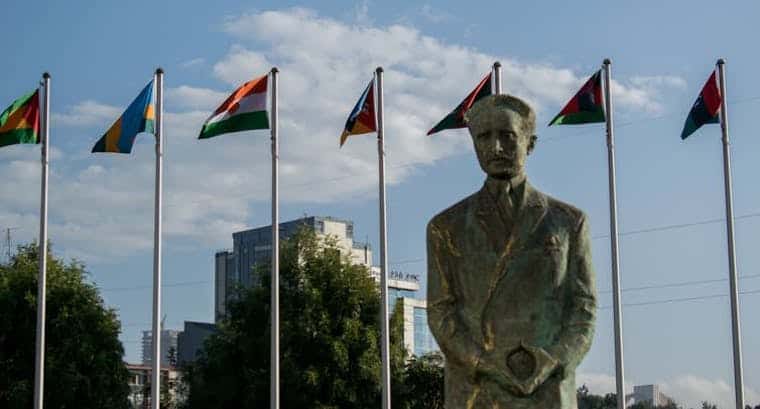
The unveiling of a statue to the Emperor Haile Selassie outside the African Union has stirred up a storm among Ethiopians and Eritreans. Some, including the Rastafarian community who still worship the Emperor as a god, were delighted. Others were furious, recalling his role in the 1973-74 famine or his suppression of Eritrean freedom.
Haile Selassie ruled Ethiopia for more than four decades, between 1930 and 1974. In 1935 his country was invaded by Italy and he sought refuge in Britain. He became a symbol of resistance to fascism in Africa, returning to the country in 1941.
An austere, aloof figure, he was finally overthrown by a group of left wing military officers in 1974, furious at the lethargy with which he had dealt with famine and the stagnation of the country. But years of war and instability since his murder and burial under a toilet in his palace, have led to a reassessment of his role and he is now seen in a more favourable light. In 2000 he was re-buried in Addis Ababa’s cathedral.
Emperor Haile Selassie is an example of how leaders have gone in and out of fashion. The movements they lead wax and wane – and with them go the reputations of those who led them. His statue, now unveiled at the African Union, is recognition of his role as a champion of African freedom against colonial intervention.
Fallen idols
In South Africa the statue of British colonialist Cecil Rhodes was removed from the University of Cape Town after students objected to his role as an imperialist. Nor did the protests end there. A whole range of works of art was removed or destroyed. This led to accusations of