
Business
The Big Thursday Read: CAB3, succession politics and the future of Zimbabwe’s democracy
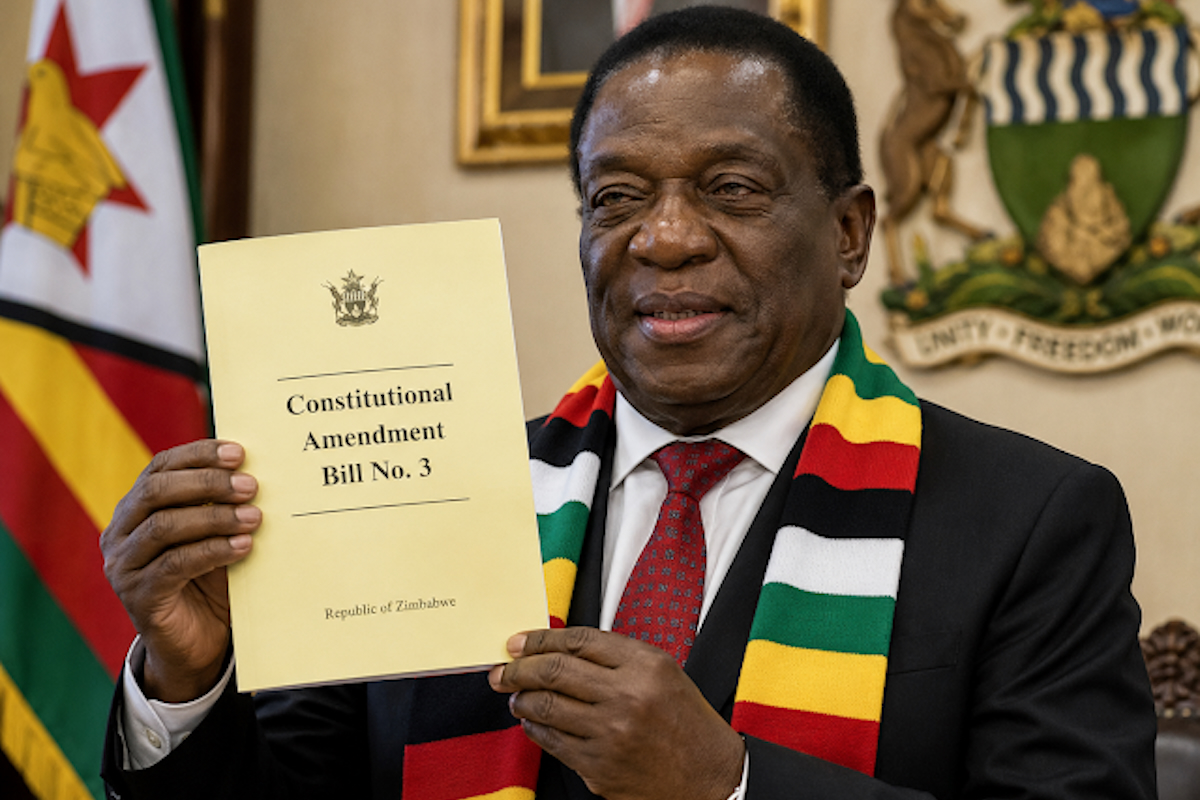
Dr. Blessing Vava examines how Constitutional Amendment Bill No. 3 has become a focal point for debates over presidential term limits, succession politics, constitutionalism and democratic accountability in Zimbabwe.

Published
5 months agoon
Introduction
Zimbabwe is currently confronted with one of the most consequential constitutional and governance questions since the adoption of the 2013 Constitution. The ongoing attempt to enact Constitutional Amendment Bill No. 3 raises fundamental issues concerning constitutionalism, democratic legitimacy, constitutional supremacy, popular sovereignty, and the protection of entrenched constitutional safeguards.
This article argues that Constitutional Amendment Bill No. 3 (2026) is not merely a proposed constitutional amendment but the culmination of a carefully sequenced political process through which democratic institutions have been progressively weakened, accountability mechanisms constrained, and conditions created for altering constitutional provisions governing executive power and presidential tenure. What is unfolding, therefore, is not an isolated legislative initiative but what one could term a “constitutional heist” carried out through the strategic manipulation of political and constitutional processes.
The argument advanced here is that developments since the military-assisted transition of November 2017 have gradually eroded constitutional safeguards and democratic accountability, creating an environment in which constitutional changes that would ordinarily encounter significant institutional and political resistance can now be pursued with relative ease. These developments include disputed electoral processes in 2018 and 2023, the restructuring of Parliament through the controversial recall of opposition legislators by Sengezo Tshabangu, the expansion of patronage networks, restrictions on civic space through measures such as the Private Voluntary Organisations (PVO) Act, concerns regarding the independence of key state institutions, and contested public participation processes surrounding Constitutional Amendment Bill No. 3.
The article further contends that the Bill seeks to achieve indirectly what the Constitution envisages should be decided directly by the people through a referendum. The debate therefore extends beyond technical questions of constitutional interpretation or political expediency. It concerns the future of constitutional democracy in Zimbabwe and the extent to which constitutional rules can be altered to accommodate the interests of incumbent political actors.
To advance this argument, the article examines the origins of Zimbabwe’s contemporary constitutional crisis, the relationship between constitutional legitimacy and democratic governance, the weakening of democratic institutions, the controversy surrounding public consultations on the Bill, the constitutional significance of presidential term limits, and the broader political context in which the proposed amendment has emerged. It argues that Constitutional Amendment Bill No. 3 must also be understood within the dynamics of succession politics, elite realignment, and competing visions for the future distribution of political and economic power in Zimbabwe. Drawing on Zimbabwe’s constitutional experience and comparative examples from elsewhere in Africa, the article concludes that Constitutional Amendment Bill No. 3 represents a defining test of Zimbabwe’s commitment to constitutional democracy, democratic accountability, and the rule of law.
The Origins of Zimbabwe’s Contemporary Constitutional Crisis
The current constitutional controversy cannot be understood in isolation from the broader political developments that have shaped Zimbabwe since 2017.
The root of Zimbabwe’s contemporary political crisis can be traced to the military-assisted transition of November 2017, which fundamentally altered the country’s constitutional and political trajectory (Raftopoulos & Mlambo, 2009; Mlambo, 2014). Regardless of how one characterises those events, they represented a significant departure from ordinary constitutional processes and raised enduring questions regarding the relationship between political power and constitutional authority, the gun versus the politics.
The legitimacy challenges that emerged thereafter were further compounded by the disputed elections of 2018 and 2023, the latter being condemned by international and regional observers, in particular SADC. Opposition parties, civil society organisations, election observers, and many citizens questioned both the conduct and outcomes of these elections. Critics argued that electoral irregularities undermined the credibility of the electoral process and weakened public confidence in democratic institutions. Whether one accepts these claims in whole or in part, it is difficult to dispute that Zimbabwe continues to experience a profound crisis of democratic legitimacy.
The significance of legitimacy in constitutional democracies cannot be overstated. Constitutional governance ultimately depends not merely upon legal authority but upon public acceptance of political institutions and electoral outcomes. Where confidence in electoral processes diminishes, questions regarding the legitimacy of constitutional change inevitably arise.
It is within this broader context that Constitutional Amendment Bill No. 3 must be situated. Many Zimbabweans view the Bill not as a neutral constitutional reform measure but as part of a broader strategy aimed at preserving political power through constitutional engineering rather than democratic renewal.
Constitutional Reform, Succession Politics and Elite Realignment
The current constitutional controversy must also be situated within the broader dynamics of succession politics within ZANU-PF. Constitutional Amendment Bill No. 3 is not merely a legal question; it is deeply intertwined with ongoing struggles over the future distribution of political and economic power within Zimbabwe’s ruling establishment. Constitutional scholars have long observed that constitutional amendments in dominant-party systems are frequently shaped by elite bargaining, succession management, and contests over control of state institutions (Cheeseman, 2015; Landau & Dixon, 2021). Constitutional change is therefore rarely a purely legal exercise. More often, it reflects deeper political calculations concerning who governs, how power is transferred, and which interests will dominate the post-incumbency order.
From this perspective, Constitutional Amendment Bill No. 3 cannot be separated from the unresolved political settlement that emerged from the military-assisted transition of November 2017. The removal of former President Robert Mugabe was not simply a leadership change; it also represented a reconfiguration of power within both ZANU-PF and the state. Nearly a decade later, many of the questions raised by that transition remain unresolved.
Despite repeatedly portraying himself as a constitutionalist, publicly committing himself to the 2013 Constitution, and declaring that he would “persuade the persuaders not to persuade him” to remain in office, President Emmerson Mnangagwa is increasingly viewed as the driving force behind Constitutional Amendment Bill No. 3, in his desperate bid to succeed himself and establish a Munhumutapa dynasty. For many critics, the Bill represents a calculated attempt to achieve indirectly what the Constitution was designed to prevent directly: the extension of incumbent political influence beyond established constitutional limits.
Significantly, the current debate has also exposed apparent unease within sections of ZANU-PF’s old guard. Before the emergence of CAB3, senior party figures often projected the view that leadership succession would occur within the constitutional framework. In one notable press conference, ZANU-PF spokesperson Christopher Mutsvangwa remarked that Mnangagwa had witnessed “what old age can do to a leader” and would therefore be conscious of “at what time one should go and not go.” Read in retrospect, such remarks may be interpreted as reflecting a broader sentiment within sections of the liberation movement and ruling party establishment that constitutional term limits should be respected and leadership renewal should occur through established constitutional processes. The push for Constitutional Amendment Bill No. 3 has therefore intensified perceptions of tension between those who favour constitutional succession and those seeking to extend the lifespan of the current political order.
His standing within sections of the liberation movement and his continued position within both the state and party structures ensure that he remains an important factor in any discussion concerning the future succession matrix within ZANU-PF.
Another noteworthy dimension of the current debate is the extent to which Constitutional Amendment Bill No. 3 appears to have generated unease within sections of the ruling establishment itself. The emergence of Constitutional Amendment Bill No. 3 has fuelled speculation that succession may no longer be unfolding according to those expectations. Reports that ZANU-PF legislators have been directed to vote openly on the Bill have been interpreted by some observers as an indication that the proposed amendment may not command unanimous support within the party. In parliamentary systems, measures enjoying overwhelming internal consensus seldom require extensive enforcement mechanisms. The insistence on visible voting therefore raises important questions regarding the level of internal dissent and the degree of confidence that the leadership has in securing support for the amendment.
Vice President Chiwenga’s position has attracted particular attention. While he has not publicly opposed Constitutional Amendment Bill No. 3, reports have suggested disagreements within senior party structures regarding constitutional amendments affecting presidential tenure and succession. These reports have been reinforced by speeches in which he has repeatedly invoked the values of the liberation struggle, emphasised the principle of “one man, one vote,” and criticised the concentration of wealth among a privileged few. Although he has not explicitly referenced the Bill, his remarks have been widely interpreted as interventions in broader debates concerning governance, accountability, and succession.
The appointment of figures such as Kudakwashe Reginald Tagwirei and Tempter Paul Tungwarara to influential the ZANU PF Central Committee, together with the reconfiguration of political alliances, has further intensified speculation regarding succession. Some analysts argue that Zimbabwe may be witnessing the emergence of a new political and economic elite seeking to inherit the post-liberation state. In this interpretation, Constitutional Amendment Bill No. 3 is not only about extending the influence of the incumbent leadership; it is also about shaping the political environment in which future leadership contests will occur.
Public debate has increasingly focused on the growing influence of politically connected business interests and the convergence of economic and political power. Some commentators have drawn parallels with forms of state capture observed elsewhere on the continent, particularly South Africa during the period associated with the Gupta family. While the contexts differ significantly, such comparisons reflect concerns that constitutional and political processes may increasingly be shaped by powerful economic actors operating alongside formal political institutions.
These developments point to a broader transition within Zimbabwean politics. For decades, political authority was largely derived from liberation war credentials and the historical legitimacy associated with the struggle for independence. Today, economic power and access to state resources appear to be playing an increasingly important role in determining political influence. This shift has generated tensions within sections of the ruling elite, including among war veterans and former military figures who strongly supported the removal of Mugabe but now appear dissatisfied with the trajectory of the post-2017 settlement.
The constitutional significance of these developments lies in the danger of transforming the Constitution into an instrument for managing elite competition. Constitutions are intended to regulate political contestation through stable and predictable rules, not to serve as mechanisms through which succession disputes are settled or factional interests advanced. The broader question raised by Constitutional Amendment Bill No. 3 is therefore whether the rules governing political authority will continue to be determined by the Constitution itself or increasingly by the strategic interests of competing political and economic elites. It is against this backdrop that the debate over presidential term limits, constitutional entrenchment, and the referendum requirement must be understood. Consequently, Constitutional Amendment Bill No. 3 should also be understood as a test of cohesion within the ruling establishment. While the Bill is often analysed through the lens of constitutional law, it simultaneously reflects deeper tensions concerning succession, elite realignment, and competing visions for Zimbabwe’s future.
The Historical Danger of Unresolved Political Contradictions
One of the most troubling aspects of the Constitutional Amendment Bill No. 3 debate is that it emerges within a political culture where major national contradictions have historically been resolved not through constitutional dialogue and democratic consensus but through force and coercion.
Zimbabwe’s political history reveals a recurring pattern in which unresolved questions of power, legitimacy, representation, and succession have ultimately been settled through violence rather than through institutional processes (Raftopoulos & Mlambo, 2009; Mlambo, 2014).
The First Chimurenga of 1896 represented a contest between colonial conquest and African resistance (Mlambo, 2014). The defeat of indigenous resistance movements resulted in the consolidation of colonial rule and the dispossession o