
Business
“British colonial system caused the Biafran War” Interview with Christopher Chukwuemeka Ejiofor, Colonel Ojukwu’s former Military Adviser
51 years ago, the federal government of Nigeria engaged in a bloody civil war with the secessionist Republic of Biafra. In this exclusive interview with This is Africa, Christopher Ejiofor, a former top military adviser during the war recalls the bitter memories of the war and how they lost everything. He talks about how the British colonial set-up caused the war and the current agitation by the Indigenous Republic of Biafra

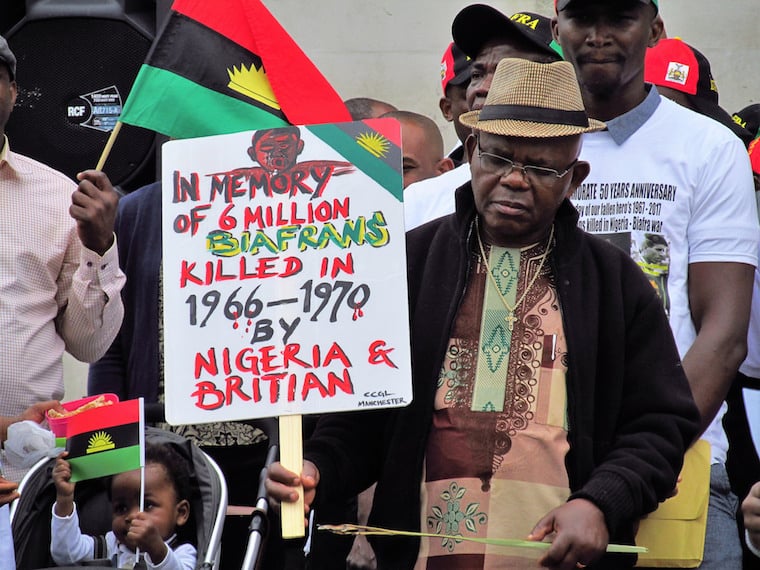
Fifty-one years ago, the federal government of Nigeria engaged in a three-year-long bloody civil war with the secessionist Republic of Biafra. Many factors have been cited as being the cause of the Nigeria-Biafra War, which raged from 6 July 1967 to 15 January 1970. More than 3 million people, mostly women and children on the Biafran side, were killed.
When Christopher Chukwuemeka Ejiofor was 16, the Nigerian government sent him to England to study. On his return, he was to help develop the emerging nation. At 21, he voluntarily joined the Nigerian army as an officer, but he defected to join the Biafran army when the declaration of the Republic of Biafra was made in 1967. One year into the civil war, he was made the Aide-de-Camp (ADC) or military adviser to Colonel Odumegwu Ojukwu, the leader of the secessionist republic during the war. In the build-up to the war, Ejiofor’s father died of a stroke when he returned from the northern part of the country after losing everything he had worked for in the pogroms and massacres of Igbo people in the North in 1966.
Immediately after the war in 1970, Ejiofor was imprisoned, but later released. He subsequently developed psychological and emotional problems and, according to him, “lost his memory for almost three years”. He then moved to England with his wife, Christine, on self-imposed exile. He did not return to war-torn Nigeria for five years. In England, he was treated for Post-Traumatic Stress Disorder (PTSD) and rehabilitated by foreign missionaries.
In 2009, he left his job as a safety inspector at East Midlands Airport in England (which he started doing after completing an engineering degree at Bristol University) to be crowned king or traditional ruler in his local community in the southeast of Nigeria after he was unanimously elected. Currently, he rules over 100 000 subjects in his Oyofo-Oghe kingdom in the Ezeagu local government area of Enugu state.
He is also the author of the book Biafra’s Struggle for Survival, his personal account of the war.
In this exclusive interview with This is Africa, Christopher Ejiofor, now 73, recalls the bitter memories of the war and how they lost everything. He also talks about how the British colonial set-up caused the war and the current agitation by the Indigenous Republic of Biafra (IPOB).
TIA: On 30 May, Biafrans all over the world will commemorate the 51st anniversary of the declaration of Biafra with a stay-at-home protest. You were there when the war started and you saw it through to the end. Could you paint a brief picture of what actually happened during the war?
Christopher Chukwuemeka Ejiofor: The background to the declaration of Biafra was that Colonel Odumegwu Ojukwu was the governor of the Eastern region, Adebayo was the governor of the West, Colonel Hassan Kastina was the governor of the North and Gowon was the actual republican president of Nigeria. They attended a conference at Aburi, Ghana, in January 1967. At the conference, they were trying to find a solution to the crisis in Nigeria; to stop people from killing each other, so that we could work together as a united body, not separately. What they settled on was a confederation of the three regions and the federal government, so that all the regions would be autonomous, with the federal capital still in charge but not with the most power, as it has now. The regions were meant to have central powers to activate and deal with most of their resources and then the central government would coordinate the three regions together. This conference was very much in the spotlight: The international press attended, including the Voice of America, BBC and other big media corporations. At the end of the day, a confederation was agreed on. Somehow, somewhere between January and May, that confederation was derailed. This meant that somebody had advised Gowon that a confederation might not be the proper or right thing for Nigeria and usually that comes from foreign powers. Gowon decided that he was going to push that (confederation) aside. But for us in the East, it was the last hope. We had suffered a lot and our people were jobless.
There were no jobs; there was nothing, and people wanted to get back to something. Instead Gowon wanted to create 12 states that would still be under the federal government’s control. That was not acceptable to us because it meant that the states would divide everybody and there would be no healing for the people of the East. Under the confederation, there would have been some room to try and compensate the Easterners for the losses and injuries they suffered. Under the federal state, no such compensation would happen. So the people of the East were not happy. There was this drifting apart between the East and the federal government and Ojukwu tried to get the East and the West together. He hoped that the two could link together with equal independent autonomy, because then there would be no war. So, on 30 May1967, before the declaration, all the chiefs and rulers of Eastern Nigeria gathered together at the Consultative House of Assembly in Enugu. They all agreed that we needed to declare Biafra. They gave the mandate to Ojukwu to declare Biafra. It was never a declaration that Ojukwu did on his own accord. It was agreed on by all the chiefs who were the leaders of all the sections in Eastern Nigeria, including Calabar, Port Harcourt, Ogoja – every part of Eastern Nigeria, and not just the Igbos. They gave their mandate and, on 30 May 1967, Biafra was declared. There was great jubilation in the East and we were thanking and exhorting God. We were hoping that Western Nigeria would do the same, then there would have been no war.
Read: Release of Leader Re-Awakens Calls for Biafran Secession in Nigeria

Igwe Ejiofor during his coronation ceremony in 2009 as king of his Oyofo-Oghe kingdom: Photo: Igwe Ejiofor
TIA: According to reports, about 3 million Biafrans were killed in the Biafran War. Can you paint that picture for us?
Christopher Chukwuemeka Ejiofor: As of 1967, there had been sadness in the heart of every single Igbo family. Nobody in the Eastern region had not lost somebody because we were mainly Christians and the Northerners targeted Christians in their massacres. So, whether you were Igbo, Ogoja, Clabar or South-South, it did not matter. All of them were killed. The pogrom had brought so much death. Thousands had already been massacred. When we declared independence, no one thought that this would happen again. No one thought it would turn into a war that would last for three years. Just imagine, the Biafran army didn’t have weapons, warships, a standing air force or navy. Unfortunately for Biafra, we didn’t get recognition from the world powers. People like America or Britain, who were like our godfather – if one of them had sponsored Biafra, there would have been no problem. As you can imagine, those who fled Northern and Western Nigeria [in the pogrom] and left their businesses and property behind, come back here jobless. Can you imagine that? They had no food, nothing. They couldn’t get a job – and then the war started. My father was one such victim. He died of a stroke because he had lost everything in the pogrom in the North. Countless people died from the heartache of loss and not having anything to do. You talk about the war itself, the killing of people, and now women and the children are the most vulnerable, because when a city was overthrown, women and children had to move to a place where there was safety. Along the way, many died from starvation and lack of resources. These are natural deaths that I am talking about, not to mention the air raids, which killed many people. They would target crowded market places and drop bombs on them, to demoralise the people. Now, when towns and cities were being captured by Nigerians, they don’t spare men. They spared no one. At the height of the war, when Biafra had lost major cities, where would people get food from? People were dying of starvation. The worst part were the children who died of malnutrition. Now we are talking about 3 million as an under-estimation. Nobody has the actual statistics. We were burying people in mass graves. You are talking about every city, losing thousands of people every day. Children were camped in refugee camps. I personally used to go to camps near Umuahia and every day people were dying there. I took many of the worst cases to Queen Elizabeth Hospital in Umuahia. When I return the next day to see my clients, they are dead.
The British army told the Nigerian navy to blockade Port Harcourt so that people could not escape. We were marooned.
I don’t know how to describe it all fully but you can see that I am painting a picture of the tragedy of the combination of loss of lives, earnings, homes, food. In fact, we were marooned. The British army told the Nigerian navy to blockade Port Harcourt so that people could not escape. If you look at Britain during World War II, they would make an escape route and send a warship to take away those who were sick and wounded to safer countries, where they would be till the war ended. But there was nothing like that for us.

London November 13 2015 106 Biafra IPOB Protest . Photo: David Holt/Flickr
TIA: After the war, the federal government introduced the three Rs: Reconciliation, Reconstruction and Rehabilitation. How honest was the Nigerian government after the war in addressing the losses in the South-Eastern and South-South regions?
Christopher Chukwuemeka Ejiofor: It was only Eastern Nigeria that suffered, no other region suffered. Easterners were running the airways, the army, corporations and all the civil service positions. After the war, nobody came back to anything because our positions had been given to people whom they (Northerners) didn’t see as threats. Would you sack that person to give me back my job? Even if that was put in writing, it wasn’t put into practice. In other words, it was just a theoretical statement made to deceive people and make them think that they were “reconstructing”. Personally I was in the UK and when I visited my home after the war, we had no running water. All our running water infrastructure was totally dilapidated. Before the war, the Americans had come and helped to put in a water system that was useable, but after the war, none of that helped. I had to raise money in the UK through my parish for a borehole to be sunk at my place. So you tell me what the people who were supposedly reconstructing and rehabilitating did? Even as we speak, most of the roads and infrastructure in the Eastern region are dilapidated. We are still suffering from the lack of power, even though, before the war, we had a more consistent power supply than we have now. So what has gone wrong? The Nkalagu cement industry doesn’t work; the coal mine doesn’t work, even though we still have large coal deposits in Enugu – but nobody is talking about it. Our mineral resources are still there and nobody is talking about them. So I cannot say that there was a reconstruction programme and it was genuinely carried out. It may have been