
Business
Youth unemployment in Uganda and the deadly relationship with illegal migration, human trafficking and modern slavery.
Uganda has been plagued by high numbers of cases of human trafficking of young people to the middle east. Due to a lack of stringent laws and minimum government intervention, it continues to be a large problem. Alex Taremwa explores the high youth unemployment rate in Uganda and how it feeds this dangerous form of modern slavery.

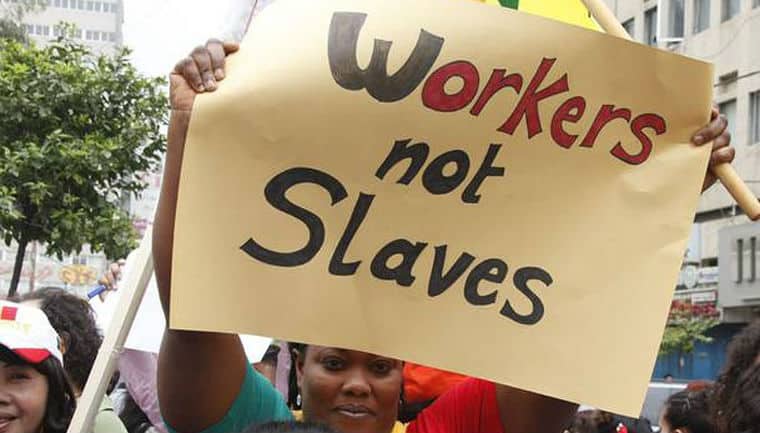
Since 2005, approximately 25,000 Ugandan men and women have supported US-led operations in Iraq. While many have returned, thousands of Ugandans are still in Iraq and have been scattered all over Middle East countries, choosing to scratch out a livelihood in Saudi Arabia, Kuwait, United Arab Emirates (UAE).
In July 2015, Saudi Arabia and Uganda entered into a 5-year bilateral agreement that would see the recruitment of one million Ugandan domestic workers to the Gulf Kingdom.
The agreement set the minimum wage for Ugandan workers at 700 Riyals ($200) a month, lower than the minimum set for Filipino, Indian, and Bangladeshi domestic workers. While the agreement has received little attention in the press, reports indicated an unjustifiable optimism in Ugandan officials’ expectations of recruitment procedures and employment conditions in Saudi Arabia. Statistics put the number of Ugandan housemaids in Saudi at 500 housemaids since the deal took effect six months ago.
However, there have been several reports about the violation of the rights of Ugandan domestic workers in Saudi Arabia. As a result, after a recommendation from parliament, Uganda’s minister of gender, labour and social development, Wilson Muruli Mukasa, banned the recruitment and deployment of Ugandans as domestic workers in any foreign country with effect from January 22, 2016.
Uganda becomes the fourth country after Indonesia, Ethiopia and the Philippines to ban their nationals from travelling to Saudi to work as domestic workers over concerns of abuse.
While the Ugandan Government had put in place legal and institutional mechanisms upon which more robust measures for detecting, monitoring, controlling and preventing illicit labour export, there still exist over 60 licensed and illegal agencies dealing in this trade.
In an exclusive interview with This is Africa, Ashaba Richard, 26, a returnee from Iraq where he was part of a joint US-Uganda mission for two years, narrated an awful ordeal of how some of his Ugandan co-ethnics had died in unclear circumstances in Iraq “fighting a war they weren’t a part of.”
“Such information is kept away from the media for ‘security reasons’ but some of our people are stuck there earning pennies and doing mundane jobs,” he says.
In yet another ordeal, Betty Nakanwagi (real identity protected) resigned two weeks after she started work as a housemaid in Saudi Arabia due to unbearable work conditions. She narrated:
“I would wake up as early as 4am and work throughout the day and night till 2am and my body ached a lot. My colleagues and I were subjected to endless work without rest, not even breaking off to sip water moreover feeding on only one meal of dry rice without any sauce a day,” she narrated in vernacular as tears rolled down her cheeks.
In another interview published in The Observer, a local tri-weekly, another Ugandan Sarah Naigaga explains how she escaped captivity in yet another Kuwait home.

Sarah Naigaga (L) and the coordinator of the national anti-human trafficking task force, Moses Binoga at the ministry of Internal Affairs. Photo: The Obsever
“Since we don’t have an embassy or consulate in Kuwait, I managed to escape and went to a Kenyan embassy and reported my case…and I was rescued. There is an 18-year-old who was taken to Kuwait by a one Matovu agency but she is currently missing and suspected to have been sacrificed by the family she was sold to. At times these Arabs kill Ugandans who go to work as maids and remove their organs and sell them to rich Arabs,” Naigaga narrated.
Naigaga adds that it is more difficult to escape because their passports were confiscated by their agencies.
The local authorities have advised job seekers to use licensed job agencies. Experts, however, argue that this will not address the root cause of migration.
The rise in illegal immigration across Africa
In Uganda, the Iraq mission opened doors to a massive influx of human resources to Arabia, Europe and the U.S in pursuit of a better life. Although some of this labour force is exported through legally binding means, the number of illegal immigrants from Africa to several parts of the world cannot be underestimated.
Away from Uganda, a recent report by the United Nations High Commission for Refugees (UNHCR), estimated that at least 137,000 people had successfully crossed the Mediterranean Sea into Europe during the first six months of 2015.
Between March and August 2011, more than 40,000 sub-Saharan Africans arrived on Lampedusa and, to a smaller degree, on Sicily and Malta. Many had been forcibly expelled by the Gaddafi regime and a large number of them applied for asylum in Italy. With the collapse of the Gaddafi regime in August 2011, the flow of migrants again almost stopped entirely But began again in 2013 with the reorganisation of human smugglers.
Youth unemployment – the Ugandan twist
The Ugandan story is, however, somewhat unique. Unlike most countries like Mali, Sudan, Somalia, Eritrea, Ethiopia, Libya et al where citizens flee the oppression and repression of their governments or prevalent political situations, Uganda has barely had a significant political uprising since 1986. Why are Ugandans fleeing their country in large numbers?
According to the National Housing and Population census 2014, Uganda’s has a total population of 34.6 million people – 78% are below the age of 30, while 52% below the age of 15. It has the youngest population in the world and the second most dependant population after Niger.
The International Labour Organisation defines youth unemployment as a share of labour force age 15-24 without work but available for and seeking employment.
In Uganda, a total of 400,000 youth are released into the job market annually after graduating at university into a labour market that has only 90,000 jobs, leaving many unemployed
The national unemployment rate is reportedly at 3.2% and 22.3% for the youth. The figures are even worse in the urban areas as the unemployment rate in the city is at 12%, seven times more than in the rural areas where it is at 1.7%.
Kampala, the capital city, accounts for 32.2% of Uganda’s youth unemployment, which translates to 36 per cent for university degree holders according to World Bank statistics.
It is from these frustrations that the youth opt to try other countries to put food not only on their tables but also for their families. Therefore the journey to Qatar, UAE, Saudi Arabia, Kuwait is not always voluntary but a product of the prevailing circumstances.

Youth Unemployment in Uganda Photo: Chimpreports.com
What has the government done?
In light of report by African Development Bank (ADB) that put Uganda’s youth unemployment at 83 per cent, the government introduced youth oriented schemes to help alleviate poverty most of these schemes have been preyed on by corruption and most have either failed or achieved little success.
These programmes include the National Agricultural Advisory Services