
Opinion & Analysis
Black Pete: race, power and identity
White people in blackface celebrated as part of a “tradition”? The Dutch are one of the most progressive people in Europe, but the controversial character known as Zwarte Piet reveals a blind spot on the subject of race. Are the Dutch not fully aware of their history?

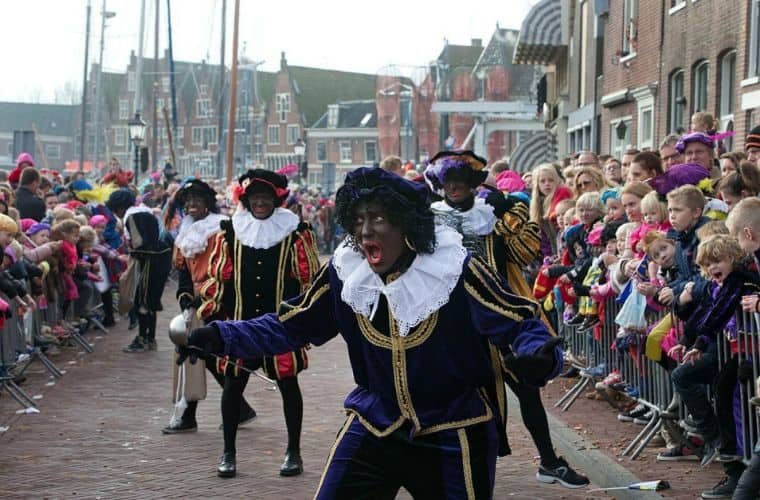
I once heard a joke that went something like this: when the world is coming to an end, move to the Netherlands because everything happens there 50 years later. A bit harsh, I thought, after all, the Dutch are a relatively progressive people with much to recommend them: from the high level of volunteering and Amnesty International membership relative to other European countries to their pragmatism and absence of hysteria around subjects like cannabis, prostitution, same-sex marriage and euthanasia. And the Netherlands is also the originating country for the World Press exhibition. Then there are the other humane and social indicators such as the unemployed being entitled to holiday money and time, and homelessness is one-fifth that of the States. On the matter of race, though, you do wonder.
The caricature
There are a number of subtle and unsubtle methods by which white Dutch people remind black Dutch people that they are tolerated but not yet fully accepted citizens. The most unsubtle of these methods happens once a year around this time, by way of a character called “Zwarte Piet” (translation: Black Pete).
In the United stated you have Santa Claus, in the UK he’s Father Christmas, and in the Netherlands he’s called Sinterklaas. Unlike the other Santas, though, Sinterklaas arrives with his slave/servant called Zwarte Piet. The slave-servant comes dressed like a renaissance minstrel: blackface, painted red lips, afro wig (for tight curly hair), classic “darkie” iconography. The arrival is a huge event: Sinterklaas and the ‘Zwarte Pieten’ make a grand entrance, and the whole parade is broadcast on public television. Sinterklaas sits tall on a white horse while his black servants share out candy to the kids on the sidelines, and families from all over the country either turn up to watch the arrival or watch it on TV. Or course, to cover the country there will be several Black Petes, typically played by white people, all in blackface, with red painted lips and afro wigs. And many people across the country dress up as Zwarte Piet, too, kids and adults alike.

St. Nicholas arriving in the Netherlands with his Zwarte Pieten (Black Petes)
The transformation, however, is not complete with the outfit and greasepaint. The character must speak poor Dutch with a stupid accent, and must act childlike and mischievous when performing, thus reinforcing an old stereotype of black people. And from mid-November, when Sintaklass and his servants arrive, right through till the 5th of December, you can see Zwarte Pieten on various television programmes and TV commercials, and on the streets, acting the fool.
At schools across the country, children sing songs referring to the skin tone and character of the black servant “…even if I’m black as coal I mean well…”, “Saint Nicolas, enter with your Black servant”, etc, and there are other old songs about Zwarte Piet in which he’s made out to be a little bit stupid, a little bit clumsy, more akin to a child than an adult, the same generalisations previously applied to black people, but which can no longer be made explicitly, so here’s a “tradition” that allows it to be made implicitly.
Bear in mind that Sintaklass is white – always white – so, essentially, the Netherland’s biggest Christmas-related celebration consists of a white man who serves as overlord to a group of stupid, forever subordinate black servants with big, red lips and woolly hair, thus mirroring the slave-master relationship of old and keeping the symbolism of the relationship intact in contemporary society.
Bear in mind, also, that the Netherlands is not a remote and isolated country unwittingly celebrating something that has no connection to its history. The Dutch were deeply involved in the slave trade, enriching themselves over centuries at the expense of millions of black people, some of whose descendants live in the Netherlands today.

Engraved in the Dutch history. A depiction of slavery on the Royal Golden Coach. Detail of “Tribute of the Colonies”, a depiction of slaves offering their goods to the royal family. It appears on the side of the Dutch royal family’s Golden Coach.
Historically, European mythology has not been kind to people of colour. European mythology hasn’t even been kind to Jewish people, but the second world war put an end to the caricature of Jews. The European tradition of portraying black people as savages, wicked and devilish or inherently dim-witted and suitable only for servitude, has mostly vanished from popular culture due to the protests and the realisation that these depictions are deeply racist and damaging, and have no place in the modern world. Americans got rid of their coon-themed iconography and the Brits have mostly done away with the golliwog figure, as they did with the Black and White Minstrel stage show which was stopped in 1987 (the TV show was stopped in 1969, following petitions and protests). Mind you, the damage had already been done. Repeated over centuries, these portrayals sit deep in the consciousness of many white (and black) people today, and continue to influence the way black people are perceived. Actually, you will still find derogatory references to dark skin in many of the classic European fairy tales, a political act woven into popular culture for kids to absorb sub-consciously.
So what on is going on with the Dutch? How can such an abhorrent anachronism exist in a seemingly modern and progressive country? As one writer put it, “millions of black people were killed or enslaved by white people over four centuries, and millions more continue to suffer discrimination all over Europe and in the States, so this Zwarte Piet character is about as funny as wearing a swastika.” If that sounds like an exaggeration, imagine what would happen today if you sang “Saint Nicolas, enter with your Jewish servant” and you immediately see that this is more than just an innocent song.
[youtube id=”r2H6SXaWxuo” mode=”normal” maxwidth=”420″]In a satirical sketch from 2007, Dutch comedy duo the Groen Brothers that takes the figure of Zwarte Piet to the limits of ridicule in order to show how he is in fact really seen.
Protests
When I first heard of Zwarte Piet, I assumed something so obviously offensive must be known all over the world, and that I was probably one of the last to hear of it. Because, to me, this looks like an insulting and deeply racist remnant from the centuries of slavery and colonialism.
But since then I’ve discovered that few of my friends and acquaintances in various parts of Africa and even in the UK had heard of it, either, and the ones who had only learned about it in the last year or so. But then, the Netherlands is a very small country (of only 16 million people) on the edge of mainland Europe, and most people probably have no reason to study it closely unless they already live there, know someone who does, or plan to visit or live in the country at some point.
I also assumed the signs that this character stereotypes black people would be obvious to Dutch people, but most Dutch people (white and black) go to great lengths to maintain that the caricature either has no racial connotations or that the racial connotations should be seen as positive, that he is not a caricature of a black servant or a racist stereotype playing step-n-fetch for his master, he is, apparently, just a “Moorish assistant” who simply enjoys doing all the work for his white friend. So celebrating this character is normal, just as people once convinced themselves that slavery was merely a reflection of the natural order, and so quite normal, too.
This denial reveals a weak, passive-aggressive and hypocritical side to the Dutch character that is at odds with their otherwise liberal, forward-thinking outlook. The Netherlands is a democratic, multi-cultural society, but this Zwarte Piet issue makes you wonder if this is in name only. Black Dutch people are tolerated, but there’s a difference between tolerance and full acceptance. Did the Second World War mark the limit of Dutch people’s ability to put themselves in the shoes of others and use the knowledge gained by such empathy to guide their behaviour in the present? Why can’t many white Dutch people empathise with their fellow black citizens? I really have no idea. It’s not peculiar to the Dutch, though. As one commenter responding to an article about Zwarte Piet put it, “I think that this can be said of all predominantly White cultures: there is a lack of empathy when people who have not historically been disadvantaged by slavery, colonialism or institutional racism and are not under- or poorly represented in popular culture, sport, music and mainstream society.

Zwarte Piet’s continued presence has aroused controversy. In recent years, protesters have gathered to object to his inclusion in holiday celebrations. (Photo credit – Bas Czerwinski/EPA)
Over the years, though, a growing number of Dutch people have started to see that Zwarte Piet is indeed a racist emblem of Holland’s colonial past. This group is still in the minority, but one of the most gratifying things about it is that it includes black as well as white people. They have been speaking out against Zwarte Piet and calling for the character to be done away with or significantly altered. Journalists like Margriet Oostveen (who writes for one of the NRC, one of the country’s most important newspapers) have written articles and columns condemning the continued celebration of this figure. Another group is petitioning the Dutch ministry of education to get Zwarte Piet out of schools, and finally, for the first time in all these years of protest, a Dutch politician and councillor (who is white) has stated publicly that it is time for Dutch society to do away with Zwarte Piet. “Sinterklaas once started without Zwarte Piet and it’s time to continue without him” she said. If it were up to her, she said, the painted face of the “Piet” would be replaced by a single wipe of carbon black. That’s similar to what John Helsloot (Meertens institute) proposed. “In essence, Zwarte Piet is a racist phenomenon”, said the researcher in an interview with The Parool (the national newspaper that reported the news on its front page). “The phenomenon is part of a traditional notion that a subservient role suits black people best.” Helsloot referred to the ratification of the Netherlands by the Convention for the Safeguarding of the Intangible Heritage as “A wonderful opportunity to say goodbye to Zwarte Piet.”
However, those who insist there’s nothing racist about Zwarte Piet typically respond to opposition with insults and even death threats. They see any opposing view as an attempt to take away their “tradition” or tell them what to do (the Dutch are a proud, independent-minded people).

“Black Pete is outdated,” wrote the influential Dutch newspaper Het Parool
I was fortunate enough to speak to some of the Dutch-Africans involved in the protest to rid Dutch society of this “tradition”, including a rapper called Kno’Ledge Cesare; he was born in Ghana but moved to the Netherlands at the age of 11. He’s one of the guys behind a campaign called “Zwarte Piet is Racisme” (translation: “Black Pete is Racism”). I will write more about Kno’Ledge in part II of this article.
But first, some background to Sinterklaas and Zwarte Piet, and then I’ll discuss the general issue of the Dutch and race. If you are already familiar with the myth, scroll down to “Race, Power and Identity”.
Sinterklaas and Zwarte Piet: the Myth and Legend
Sinterklaas is based on a real Turkish bishop from the Middle Ages who hailed from the city of Mira in what is modern-day Turkey (as someone wrote, we have so normalized whiteness as a monolithic representation of humanity that we accept Santa as white). After his death, the Byzantium declared him a saint (I’m not sure how, but apparently his remains ended up in what was then a Spanish City, which is why the tradition says that he comes from Spain), and since then he has been remembered during a widely celebrated annual holiday in offices, schools and homes across the Lowlands (Belgium, Luxembourg and the Netherlands), the idea being to give each other presents and irony- and humour-rich poems poking fun at one another. Children are taught to believe that their presents are from Saint Nicholas (Sinterklaas) who is accompanied by a black servant called ‘Black Peter’, and adults dress up as Saint Nicholas and Black Peter (a white person painted in black face), and visit children and adults.

St. Nicholas, Patron Saint of Children, Sailors, Thieves and the Falsely Accused
Originally, the character that accompanied Saint Nicholas symbolised the devil, a submissive, frightening and disobedient “joker”. Saint Nicholas was eventually banned, but reappeared at the end of the 18th century, this time alone.
The devil character eventually returned, but this time as a servant of Moorish descent (Spain was part of the Moor empire), wearing the costume of child slaves working in Europe at the time. The character carried a large bag and a rod and threatened to abduct children who behaved badly. The racial ideas from the era of slavery and colonialism were translated into the character.
But “Moor” as a term referred to one of the many different groups originating in North Africa (that at one time controlled Spain), and the physical traits of the Moors varies, however the depiction of Zwarte Piet has remained consistent: dark skin, tight, black, curly hair and red lips. It’s worth remembering that this was a time when few white people anywhere took the feelings of black people seriously. Most Dutch people at the time had never even seen a black person, and colonialism and racial superiority were still very credible ideas.
Then in 1850, a Dutch school reached called Jan Schenkman published an illustrated children’s book called Saint Nicholas and his Servant. In the book, Sinterklaas arrives by steamboat from Spain with a black servant of African origin (the name “Piet” doesn’t appear until 1891) who helps him on his rounds. At the time, the Dutch empire spread across three continents and included the colonies of Suriname and Indonesia. As mentioned earlier, the Dutch were deeply involved in the slave trade, transporting African slaves to be sold and using slave labor to work coffee and sugar plantations in their colonies. At the time, minstrel shows were a popular form of entertainment.

St Nick before Schenkman

Illustration from Schenkman’s book, circa 1885
One can debate whether Piet was supposed to be a Moor or the devil, or even how Moors appeared to European eyes, but looking at how the Dutch (and other Europeans) depicted black people at the time, it’s hard to see anything but a caricature of black people in the figure of Zwarte Piet.
Writer Lulu Njemileh Helder notes that “the combination of the small Black Peter and horse-riding Saint Nicholas, represents the triumph of good over bad, Christian over heathen, and later, Christianity over Islam. They’re caught in a relationship of dualism. Of this dualism, Val Plumwood writes: ‘dualism … results from a certain kind of dependency on a subordinated other. This relationship of denied dependency determines a kind of logical structure, in which the denial and the relation of domination/subordination shape the identity of both the relata.’ (Plumwood in Gravenberch, 1998). Gravenberch points out that: ‘the contrast between the Saint Nicholas and Black Peter stands in a long tradition of dichotomised representation in which Europeans portrayed themselves and Africans as essentially different: Europeans as rational responsible, civilised, mature and as masters. Africans as irrational, wild, childish and as slave’. Saint Nicholas is being portrayed as everything Black Peter is not. The Saint is an old white, wise, and articulated man. Peter is a young, black, simple, cheeky (classically followed by a reprimand from the Saint), boy.”
Rationalisations
Over the years, the Dutch have tried to rationalise their continued celebration of the character; they decided, for instance, that his dark appearance is due to his having come down a chimney to leave the presents, i.e. the blackface is soot – but this explanation obviously doesn’t hold water; if soot, how come he doesn’t simply have a few smudges rather than being black all over, and when did soot ever turn anyone’s lips red or give them a curly afro? Still, the explanation is peddled.
Other rationalisations include:
1. Black people take part, too.
Well, yes, some do, and will continue to defend it to the hilt until somebody calls them Zwarte Piet (which happens) or until someone points out the similarities between the way Zwarte Piet looks and the way Dutch people used to depict Africans during the era of the slave trade and colonialism. As Laura Bijnsdorp, writing in the Daily Herald, noted: “I attended a formal debate on the topic [of Zwarte Piet]. The moment that it all became real to me was when the question was asked: Who has ever been called Zwarte Piet? About sixty percent of the room lifted up their hand, the other forty percent that did not raise their hand being the white audience, including myself. My friend next to me had lifted her hand as well, telling me afterwards that twice a child had called her Zwarte Piet, and both times the parents did not correct the child. It’s just a child though and he/she means well, because they like Zwarte Piet. I realized, seeing those raised hands, that a child does make a link between Zwarte Piet, the mischievous helper, whose current depiction stems from slavery, and a person of African descent. It’s not a very positive image. Every year people that know the history must look at a reenactment of colonial slave-times being celebrated. To some it might be an innocent children’s holiday but to others it must be painful having to smile as the country cheers on Sint Nicholas and his helpers.” It’s like that Bill Hicks joke where he asks if Jesus would really want to see so many reminders of his Crucifixion hanging from chains around people’s necks if he returns. There were slaves who, born into slavery, couldn’t see what all the fuss about freedom was for, either. It doesn’t mean slavery was good for them.
2. Zwarte Piet isn’t from sub-Saharan Africa, he’s from Morocco, or Spain.
Ok, but then why is his skin so dark, rather than olive-coloured, and why are his lips red? And why does he have an afro? And why does he behave like a fool?).
3. But the kids love it, so what can we do?
I’m sure American kids loved their coon-themed toys, too, but that was no reason to hang onto them. How about doing what the Dutch-speaking Belgians in the region of Flanders did? They altered the tradition by making Sinterklaas a black man and Pete his white helper [According to my source, this alteration to the tradition only happened in one Belgian city.] After all, if everyone is indeed equal – as the Dutch insist – and if Sinterklaas and Zwarte Piet’s relationship isn’t symbolic of the master-slave relationship, then there’s no reason why this switch should be a problem.
4. I’m not a racist.
It’s possible to not be a racist and unwittingly participate in a racist act.
5. It’s harmless fun. We don’t see Zwarte Piet as a black person, and neither do kids. They see him as Zwarte Piet.
Why, then, do some white kids call black Dutch people Zwarte Piet? Some are clearly making the connection. And why do you have white adults calling out to their black colleagues, “Hey, our very ‘own’ Zwarte Piet!”? One commentator, Martin, who clearly doesn’t buy the Zwarte Piet is “harmless fun” rationalisation, wrote “If the Dutch government thinks that Zwarte Piet is correct, just invite Barack Obama over for dinner on the 5th of December. But we all know they ain’t gonna do that; they ain’t that dumb.”
