
Politics
The geometry of grief
The South African-Nigerian novelist Yewande Omotoso has reimagined her deepest loss in An Unusual Grief, the darkly funny story of a mother who infiltrates her dead daughter’s life.

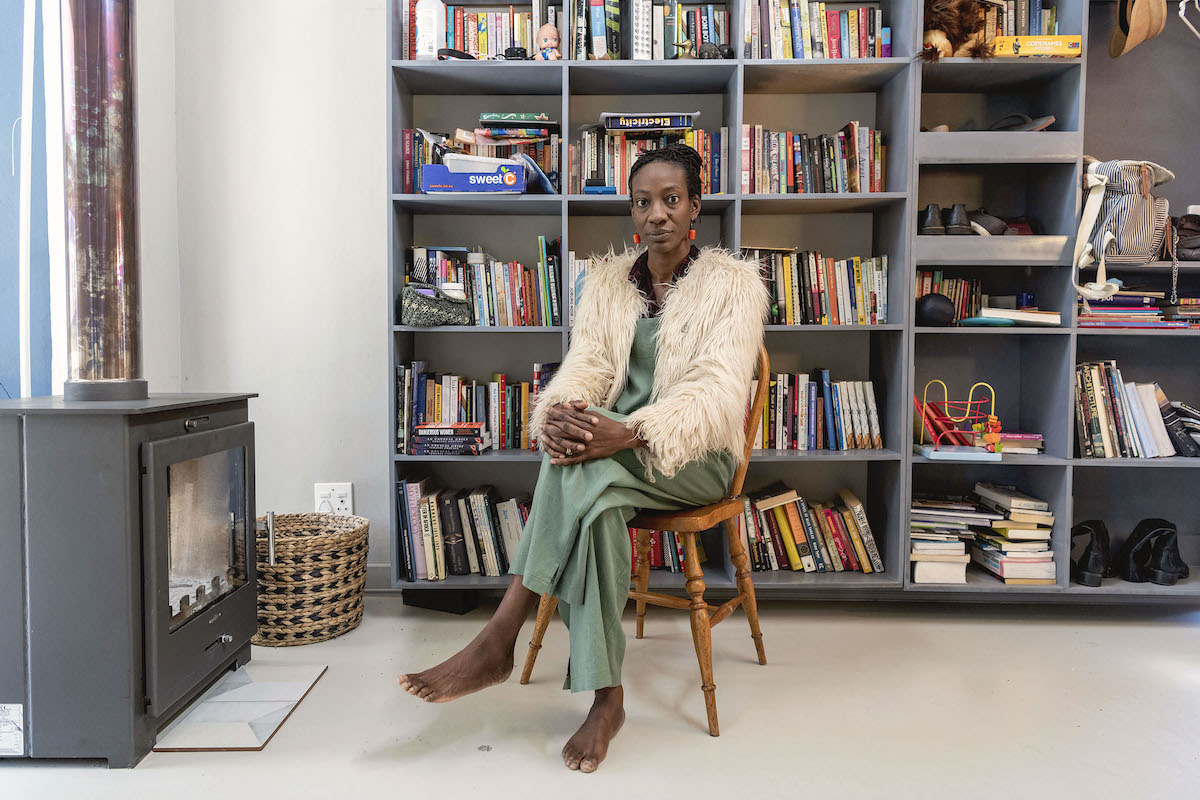
In Yewande Omotoso’s third novel, An Unusual Grief (Cassava Republic, 2021), a Nigerian immigrant in late middle age leaves her husband to travel from Cape Town to Johannesburg. Her project, it transpires, is to snoop on her daughter. But this is no typical marital break-up, and no typical exercise of maternal nosiness: the daughter, Yinka, has committed suicide, and her mother, Mojisola, is desperately trying to resolve her shock and self-reproach. In order to mourn Yinka properly, Mojisola craves a sense of how she lived – and why she decided to stop.
If that premise suggests a gloomy book, think again. Omotoso is a taut and witty storyteller and Mojisola’s curiosity leads her to surprising places, both in Yinka’s milieu and within herself. Grief is not the monolith of sorrow that we tend to expect. It is “dynamic” and “unruly”, according to Omotoso – as is the Johannesburg that Mojisola discovers.
RELATED ARTICLE:

Or, to be more accurate, the Midrand that she discovers. It’s a place far from the lurid African Gotham of Joburg’s accreted fictional presence, which seems to consist entirely of ghettos and palatial opulence. The action of An Unusual Grief plays out in the sprawling, humdrum space between: on the face-brick savannahs of middle-class atomisation, from Midrand to Edenvale to Randpark Ridge, teeming with townhouse estates for “normal” people – who tend to lead “abnormal” inner lives, as Mojisola comes to realise.
Temperamentally anxious and controlled, Mojisola also surprises herself by expanding and relaxing into all this strangeness. She quickly strikes up a rapport with Yinka’s prickly, ganja-dealing landlady, and then with denizens of Yinka’s demi-monde. Mojisola’s route to some form of resolution takes her through twisty erotic terrain, and the novel’s mischievous treatment of the imperious lust of a grief-stricken older woman is one of its many victories.
Of cities and signifiers
In an interview with Omotoso, Johannesburg Review of Books editor Jennifer Malec joked that An Unusual Grief might be “the first great Midrand novel” – and Omotoso laughs when I mention this.
“Creatively, I’m interested in restraint,” she says, “and in finding unusual ways to capture the small-t ‘truth’ about something. So I like the idea that the novel’s setting is in Joburg, but it’s not Joburg – the conceit of Joburg, using the typical signifiers. I do feel that Midrand hasn’t been fully milked in the novel, though. There is so much more in Midrand.”
RELATED ARTICLE:

Omotoso knows very well how to read cities and their signifiers, having studied architecture at the University of Cape Town (UCT) and worked as an architect. It was far from her first choice of career – she had wanted to be a writer ever since she arrived in Cape Town from Ife, Nigeria, as a 12-year-old, with her family.
That narrative urge soon found fuel. Suddenly, this Yoruba kid found herself in a newly multiracial “model C” junior school, Golden Grove Primary, in 1992 – walking corridors in which Black kids were vanishingly scarce and Nigerian kids were inconceivable.
“Being made strange to myself at age 12, when all you want to do is to be familiar, to belong, that placed in me a recurring preoccupation in my writing: the idea of belonging in all its guises,” she says. “When you are strange, you look very carefully at everything. I didn’t have the luxury of comfort; I had to be on guard. It’s not necessarily pleasant, but I guess one result is that you are keen and able to observe.”
A plan for freedom
But by the time she finished school, her father, the renowned Nigerian author and literary scholar Kole Omotoso (also the “Yebo, gogo!” actor in the famous Vodacom television adverts) declined to bankroll the fees for a literature degree. He knew the pitfalls of living by the sweat of your pen.
“He was like, ‘Mm-mm! This isn’t going to happen.’ My teachers looked at my marks and said, ‘Well, she has a bit of this and that.’ So they all conferenced and decided architecture would have some creativity in it, but was also technical, and my results pointed in that direction.”
Omotoso would need to be pragmatic to beat this pragmatism. She set about gradually buying her passage to a writing life, at first by using her architect’s salary to pay the fees to write her first novel, Bomboy (2011), as part of a master’s degree in creative writing.
“I didn’t love architecture for many years,” she says. “I hated it. I hated the school. This was the end of the 1990s and UCT was pretty interesting back then. The department was difficult; it was run by white men, and with hindsight it was a difficult place to be as a Black woman. But it was the water we swam in. I couldn’t name it for a long time. We were just unhappy, and confused – fairly intelligent students performing badly. We weren’t at home and we weren’t received.”

She hastens to add that several lecturers eased this sense of systemic alienation – notably the writer and architect Lesley Lokko, who has just founded the African Futures Institute in Ghana. “She made a huge difference to me and others like me.”
And Omotoso does feel that architecture has helped her writing – by instilling an urge towards the unity of concept and form. “In architecture, the preoccupation is with this kernel of an idea that is then reflected in a building, and the same process takes place in a good novel.”
After graduation, she worked in and around architecture for a decade. And all the while, she wrote and wrote and wrote by night. Bomboy, whose protagonist is a troubled adopted child in Cape Town who discovers a family curse in letters from his real father in Nigeria, was shortlisted for the Etisalat Fiction Prize. Her second novel, about two grumpy old women and racism, The Woman Next Door (2017), was shortlisted for the International Dublin Literary Award. An Unusual Grief is a good bet to go even further.
For the last few years, Omotoso has been living by the sweat of her pen. “So it’s a happy ending.”
Inverting the moment
She has just made a happy beginning, too. Her 21-month-old twin sons joined her at last month’s Franschhoek Literary Festival, the first edition to be held in person since 2019 – where she was in conversation with the academic and book critic Wamuwi Mbao.
For Omotoso, motherhood has added a jolt of personal resonance to An Unusual Grief, whose premise of a mother mourning a daughter deliberately inverts her own bereavement story: she was 23 when she lost her mother, Marguerita, to cancer. She was an urban designer from Barbados, who met Kole when they were both students in Edinburgh and then moved to Nigeria with him to raise Yewande and her two brothers.
“Most of the book was written way before I was even trying to have kids, to be honest – and long before I was pregnant,” she says.
The construction of Mojisola was improvisatory, she says, which is her standard process – a winding, capricious collaboration between character and writer. Early on, Omotoso imagined that Mojisola might wind up as a full-on dominatrix, but Mojisola put her foot down.

“Mojisola leads a very scripted life, and the tragedy of her daughter’s death suddenly gives her permission to write her own script,” Omotoso told Mbao. “When I was imagining her responses, I thought a lot about my aunts, my dad’s cousins – not so much because I needed her to be believable but because I needed to temper my own conceits about where she might go.”
Mojisola’s uncanny process of grief – at first a distraught fugue state, and then a kind of darkly exhilarating surrender to repressed drives – was informed by Omotoso’s own experience of the surreality of surviving a loved one.
“Apart from the birth of my kids, the loss of my mother was the event that has impacted my life the most,” she told Mbao.