Sarala Krishnamurthy, Namibia University of Science and Technology
Under the Hanging Tree is a new film written, directed and produced by Perivi Katjavivi, a young, up-and-coming Namibian filmmaker.
Despite two decades of gradual growth in the fledgling Namibian film industry, only about 20 features have been produced by the southern African country so far. Katjavivi’s efforts at writing, directing and producing are to be lauded. Under the Hangman’s Tree is his third feature and it premiered in the official selection of the prestigious International Film Festival Rotterdam. Katjavivi’s films offer political themes that reveal the dark underbelly of Namibian society. His narratives expose the devastating effects of colonialism, still felt today.
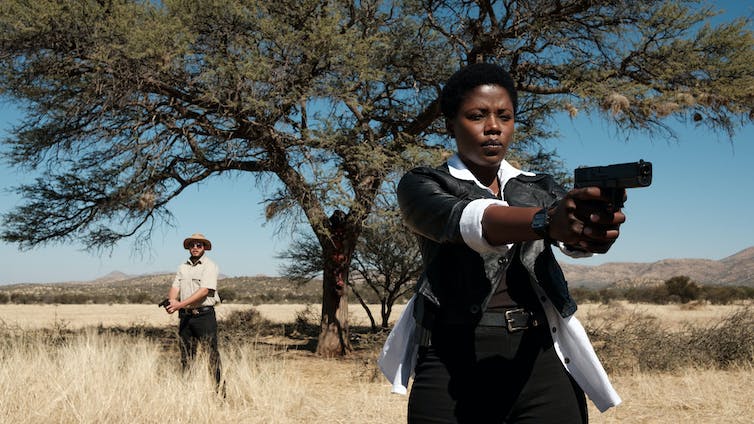
Under the Hanging Tree is about Christina, a police officer who must investigate a murder on a farm. She is a Herero woman who has given up her tradition and culture in pursuit of a successful career. The mostly nomadic Ovaherero people were a Bantu grouping who arrived in central Namibia in the 1700s. Their descendants constitute 9% of the population today.
Between 1904 and 1908 tens of thousands of Herero and Nama people were massacred by forces of the German empire in a genocidal act of ethnic cleansing. This is described as the first genocide of the twentieth century and a “dress rehearsal” for the Holocaust that was to take place in Europe a few decades later.
This poignant film traces the growth of Christina’s character from a young woman who is colonised and uprooted from her culture to one who acknowledges her heritage and its tragic history. The film plays out slowly – sometimes too slowly – but in the process it grasps the heart of the matter. It leaves a viewer thinking deeply about how the past influences the present.
Opening scenes
The two opening scenes juxtapose one another and set the tone for the rest of the story.
An old Herero man at a ritual fire is invoking his ancestors and calling on them to come and bless their children. This cuts to Christina, arguing with her aunt Ndjambi, an elder who wears the typical Herero dress. She wants her niece to help hang their clothes out to dry but they argue. Christina considers it undignified to do this kind of work because she is educated and a professional. https://www.youtube.com/embed/SKMW5Z9yRQY?wmode=transparent&start=0
The Hanging Tree will proceed to gradually unfold, revealing a society torn between the old and the new, between tradition and modernity.
What it’s about
Christina and her colleague must investigate a murder that has been reported at one of the German farms in present day Namibia. There remain many farms owned by the families of original German settlers in the country. She discovers the farm owner hanged on a tree by an unknown person, echoing what happened more than a century ago when Herero people were hanged by the Germans from trees like this one.
In his story, Katjavivi brings to life the transgenerational trauma of a community. The film is alive to the mood of the nation, where discussions around German