
Culture
Robert Nesta ‘Kwabena’ Marley, African philosophy and Agenda 2063
Reggae legend, Robert Marley who died on 11, May 1981 would have turned 75 this year. Marley sang about the struggles of African people while signifying the need for Pan-African unity. As far as the African dream of a free, united and strong Africa is concerned, the words of Marley continue to be relevant to the fight for the total liberation of the continent.

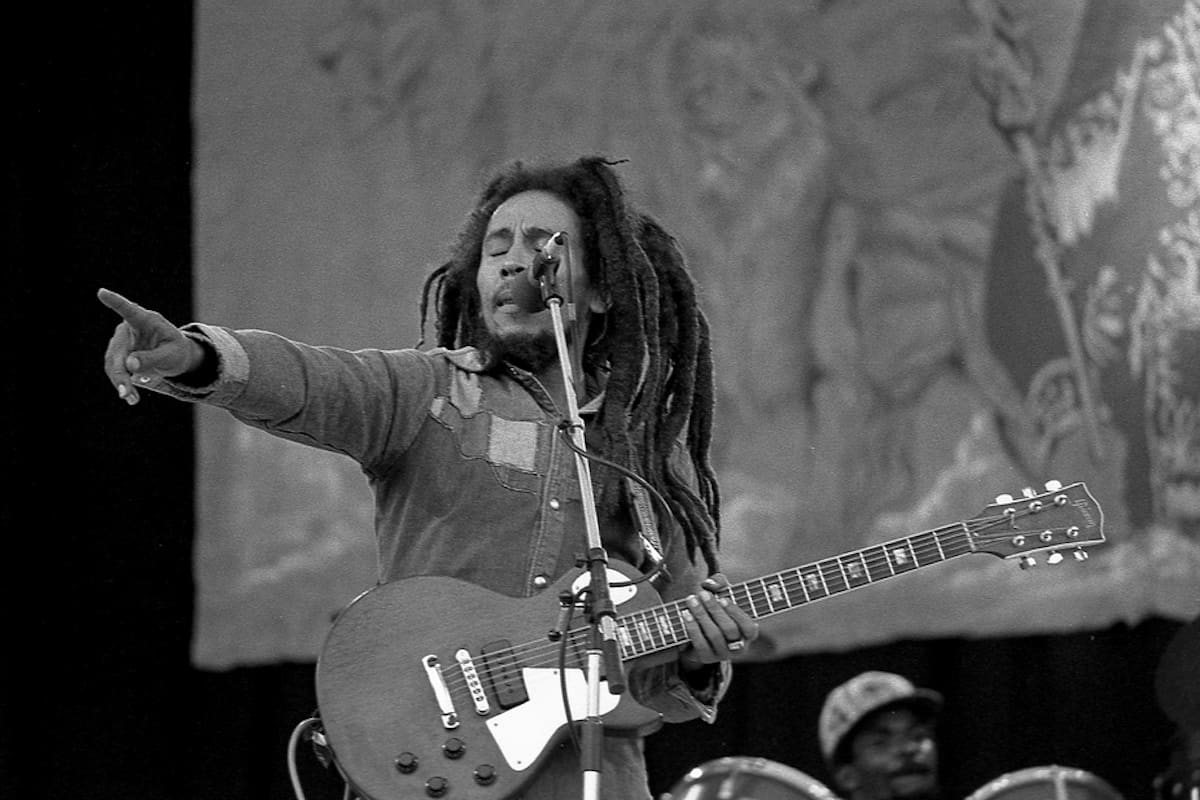
Reggae legend, Robert Nesta Marley who died on 11, May 1981 would have turned 75 years this year. “Third World hero, icon, international superstar, king of reggae, protest singer, representative of the oppressed, the pride of Jamaica, a troubadour in difficult times, legend.” This is the cocktail of words Martijn Huisman chose to introduce his readers to who Marley is, in the preface of his book, Babylon by Bus: Bob Marley and the Wailers in the Netherlands.
Bob Marley was born in Nine Mile, St. Ann Parish—which is the same birthplace of the Honourable Marcus Garvey (Barrett, 1997) and Winston Rodney (Burning Spear)—on 6th February 1945 to a white father, Capt. Norval Sinclair Marley, and an African mother, Cedella Booker. In Bob Marley: A Biography by David V. Moskowitz, he indicates that the exact time of Marley’s birth was 2:30 pm. Born in the rural and low-class community of Nine Miles, Marley grew to become a thorn in the flesh of the white oppressors, thereby challenging the status quo: the subjugation of Africans all over the world. His sojourns across the globe, from his homeland Jamaica, Europe, Central America, Africa to faraway Japan, brought renown to Bob Marley and the whole island of Jamaica.
Therefore, as part of the worldwide celebration to honour the life and work of this Pan-Africanist, peace broker, freedom fighter, and lifetime ambassador and patron of the Rastafari movement as well as reggae music, this treatise positions the life and work of [Kwabena] Marley within the purview of African philosophy (pan-Africanism) through a study of his personality, lyrics (message) and awareness of his African roots. Also, I situate Marley’s works, which many perceive as prophecies, in a contemporary context of the 21st-century African struggle and the discourse of Agenda 2063, which is a blueprint for the holistic adoption of pan-Africanism for the transformation of Africa. Mooted in 2013, Agenda 2063 encompasses the social, cultural, political and economic issues of Africa, and makes a long-term projection of the state of Africa by the said year having adequately addressed the pitfalls within the aforementioned spheres of African life, through pan-Africanism.

Bob Marley live in concert in Zurich, Switzerland, on May 30, 1980 at the Hallenstadium. Photo: Wiki commons/Ueli Frey
Even though Marley was neither literate nor an intellectual—in terms of formal education—one would concede that he exhibited a splendid cognisance of issues—politics, religion, social injustice, cultural alienation—militating against the progress of Blacks. He embarked on what can rightly be referred to as “a pedagogy of the oppressed” in that, he enlightened African people of the need to redeem themselves and reclaim their identity, which suffered grisly as a result of centuries-long domination through slavery and colonialism. In an amusing twist to the claim that Marley received no formal education, Prof. Horace Campbell, in Rasta and Resistance, is of the view that it was with the Rastafari movement that Marley had his formal education. In 1978, introducing his interview with Bob Marley on NBC News in New York—while Marley was in exile after there had been an assassination attempt on his life—Bruce Morrow said “Bob Marley’s music concerns itself with political tension, social injustice and black roots… most Jamaican musicians are Rastafarians; it’s a sect that believes Jamaican culture should reflect its African heritage.”
Read:‘In the Abundance of Water, the Fool is Thirsty’: Bob Marley and the Pan-African Dream
It is in light of this that I perceive of Marley as an African philosopher; thus to say he sourced his philosophy (thinking) from his deep-rooted connection with the African blood which coursed through his veins (the reason why Kwabena Marley appeals more to me than his ‘Christian’ name, Robert). Thankfully, a number of evidences sustain my description of Marley. Prof. Horace Campbell clarifies by suggesting that “Marley identified with Africa and broke the long tradition of mixed-race persons who denied their African heritage.” According to G. Tubei, “Bob Marley loved Jamaica but he was in transit and Africa was the destination. He not only loved the continent symbolically but also in a real sense.” Speaking to The Guardian, Rita Marley, Bob’s widow and member of The Wailers’ backing vocalists I-Threes, stated that “Bob’s whole life is about Africa, it is not about Jamaica;” “How can you give up a continent for an island?”, she asked.
Again, as to why I find a convergence between Marley’s words and the aspirations stipulated in the Agenda 2063 framework, his words have lived on for over 46 years (since the release of Catch a Fire album) and if anyone ever questioned me about the likelihood of extinction of his name and messages, my response would be: I see no light at the end of the tunnel. According to the African Union Commission (AUC):
The aspirations [of Agenda 2063] reflect the desire of Africans for prosperity and well-being, for unity and integration, for a continent of free citizens and expanded horizons, with freedom from conflict and improved human security. They also project an Africa of strong identity, culture and values, as well as a strong and influential partner on the global stage making an equal contribution to human progress and welfare – in short, a different and better Africa (AUC, 2014:10).
Interestingly, I chanced upon a comment under a video of Marley’s performance at the Oakland Auditorium in 1979, which gave credence to my thoughts expressed in this article. Rick Fountain, Jr. wrote that “5000 years from now Bob will still be with us!” Marley sang about the struggles of African people while signifying the need for Pan-African unity on the African continent to launch an onslaught on Western oppression and exploitation. Insofar as the African dream of a free, united and strong Africa is attained, the words of Marley continue to be relevant to the fight for the total liberation of the continent. I mean, what striking difference is there to be seen between the songs (chants) of Marley and the rantings of Ghana’s first Prime Minister and President, Osagyefo Dr. Kwame Nkrumah? Possibly, it is the reverse of the similarities between these astute individuals of the 20th century.

Kwame Nkrumah during a state visit to the United States. Photo:
Abbie Rowe – John F. Kennedy Presidential Library and Museum/Wiki
In Redemption Song, Marley begins with the poignant narration of how his ancestors were forcefully shipped from Africa in slave ships to foreign lands: “Old pirates, yes, they rob I. Sold I to the merchant ships Minutes after they took I (sic) from the bottomless pit.” This song was on Marley’s last album Uprising released in 1980. He acknowledges that despite the transgression and ordeal suffered, “we forward in this generation, triumphantly”. Though not exclusively his own words, Marley goes on to admonish blacks (Africans) that: “Emancipate yourselves from mental slavery; none but ourselves can free our minds.” This was a clarion call to blacks by Marcus Garvey who maintained that while others may liberate our bodies, none but ourselves can free our minds (Garvey, 1925). Garvey’s central ideas, which led to the formation of the U.N.I.A were race first, economic empowerment through self-reliance, Black Nationalism, the centrality of Africa and the liberation of Blacks from mental slavery.
With Marley’s call on Africans to “emancipate ourselves from mental slavery,” Campbell believes that it is a passionate advice for “intellectuals and the activists to make a break with the epistemologies that justify and cover up oppression.” Looking at the 21st century now, with neo-colonialism still blossoming on the African continent, the emancipation project has been left unattended to by Africans (notably the leaders on the continent); by “emancipation” Marley seems, in this time, to mean the renewal of and disentangling our minds from Eurocentric standpoints and to embrace Afrocentric perspectives, which will nurture our awareness and appreciation of the African reality. The resurgence of the African personality, as trumpeted by Dr. Nkrumah, will ensure that Africa receives a facelift in international affairs or its relationship with the rest of the world (globalisation).
According to Molefi Kete Asante, “Afro-centricity is an intellectual paradigm that privileges the centricity of Africans within the context of their own historical experiences.” It seeks to challenge Euro-centric viewpoints and its domination on African people as a result of the slave trade and colonialism. Euro-centrism presents a racist, divisive, ahistorical, and dysfunctional view of world history. While we free our minds, “none but ourselves” reminds us of the daunting task which behoves on Africans to ensure the total redemption of the continent. It is only when this is achieved that we can finally lend our voices to Marley in joining the masses who will be singing the freedom songs with him in 2063 when he calls out “Won’t you help to sing these songs of freedom?

Marcus Garvey, National Hero of Jamaica, Image Credit: Wiki
Additionally, Marley talks about what Worth (1995) has pointed out as a commonality between all Rastas—the rejection of Babylon—in Babylon System (1979). The teachings of Rastafari calls for a total abhorrence of Babylon, a place Rastafarians perceive as the abode of oppressors. Babylon, for Rastas, denotes Western society. This is seen in Hagerman’s (2012:384) insistence that “Babylon is the root of oppression.” The Rastas’ belief that Babylon’s mission is to put God’s [Jah] creation asunder fuels their determination to reject the dealings of Babylon, as seen in the opening verse of Babylon System:
We refuse to be
What you wanted us to be
We are what we are.
That’s the way it’s going to be if you don’t know
Rastas are convinced beyond measure that Babylon is the progress that was made possible by the oppression of Africans (Worth, 1995). Reference can be made to Walter Rodney’s How Europe Underdeveloped Africa, in which he averred that the underdevelopment of Africa is as a result of calculated schemes of domination and impoverishment of African peoples. This suppression of Africa has operated on cultural, political, economic and social levels of African life.
Certainly, Africa has not lived up to her full potential as a continent endowed with vast natural and mineral resources; but it is important now more than ever, as we advance in the 21st century, to turn around the fortunes of the continent of Africa. It is expected of Africa to look within herself for solutions to her problems as well as strive to break free of the snares of these nations and their multinational corporations that continuously fleece Africa. This is captured appropriately in Marley’s words “Babylon system is a vampire sucking the blood of the sufferahs (sufferers).” In another song Chant down Babylon, Bob Marley charged fellow Rastafarians [Africans] to “Come we go burn down Babylon.”
Just as Marley rightly sings:
Yes, we’ve been trodding on the winepress much too long
Rebel, rebel!
To ‘Rebel’, [against neo-colonialism (Babylon system)], Osagyefo Dr. Nkrumah in his book, Africa Must Unite (1963), and Marley in his 1979 classic, Africa Unite on the Survival album, are both conscious of the legitimacy of the purpose for which the unification of Africans, both home and abroad, is a must. Perhaps, this fine line between [Kwabena] Marley and Kwame Nkrumah evidences the fact that both individuals were hugely influenced by the Philosophy and Opinions of Marcus Garvey. In an interview with Gil Noble on his television show ‘Like It is’ in 1980, Marley cited Garvey of Jamaica and Haile Selassie of Ethiopia as individuals who significantly influenced him as a musician, a reggae musician for that matter. One would notice from the footages of Marley’s live performances on stage that the pictures of Haile Selassie and Garvey were always displayed in the background alongside the Ethiopian flag with the Lion of Judah embossed in it.