
Business
The Pan-Africanism of it all
Oh. The definition of PanAfrican must have changed recently.

I love Adelle Onyango.
I want to say that upfront, because what now follows started with a post of hers on Instagram – a reaction to what’s been happening in Nairobi these past two days – and I want you to understand why her name, specifically, unfurling this thread of thoughts in my mind, isn’t an accident.
If you don’t know Adelle, in one take: In all the time I’ve known her, she’s one of those people whose commitment to saying the true thing, even in the most uncomfortable of spaces, isn’t a performance. It’s just what she does.
October 2021. Emmanuel is hosting a summit in Montpellier, France. The short version: No heads of state invited. Thousands of young Africans instead – artists, businesspeople, athletes… The stated purpose: To demonstrate a “new” France-Africa relationship, built on listening to youth.
Adelle takes the stage. Emmanuel is part of her audience – on stage with her, in fact, as part of a panel presentation. He’s seated to her right, doing that thing that big men with power do to show that they are paying attention even when they’re being told things they don’t like: Nodding and taking notes. Even with the slight quiver in her voice, her eyes radiate her conviction.
“We as Africans feel the pain of colonisation every single day. The lack of a clear and strong acknowledgement of the continent’s pain on this destructive past results in scepticism. What we end up with is scepticism of what exactly does France stand for… In fact, the air of denial that France chooses to sit in is uncomfortable, not only for Africa but also for France, and it does no good for either one of us. How can you trust the source of your pain when the source doesn’t acknowledge it?”
Then she unloads the question:
“How strong can a relationship that is built on pain, that is built on scepticism, and that is built on lack of trust really be?”
(I’m revisiting all this with good reason, so stay with me for a moment.)
And she continues with:
“We, not just as a team here, but all of us in this room, and the 5,000 who helped with the report, and the millions more on the continent, and off of the continent, want a commitment from you, Mr. President, that you will join us in the eradication of La France-Afrique, which is a very unfair dominance, and it has to end.”
The room erupts.
Later, she says this about why she spoke the way she did:
“When presidents meet they cannot tell the truth as they have deals they want to seal. But for me, I had no deal to seal.”
Macron is in that room. He hears her. He hears all of it. He hears the specific indictment, delivered by a young Kenyan woman with no deal to seal, in front of thousands (and later, thanks to the world we live in, millions) of witnesses.
He deflects. He says he doesn’t believe in “a politics of repentance.” He promises France would introduce an honest assessment of its colonial past into school curriculum. Bla-bla-bla, and all the non-commital politico-speak.
He doesn’t apologise. He doesn’t commit to ending la Françafrique.
And then. And then.
Five years later.
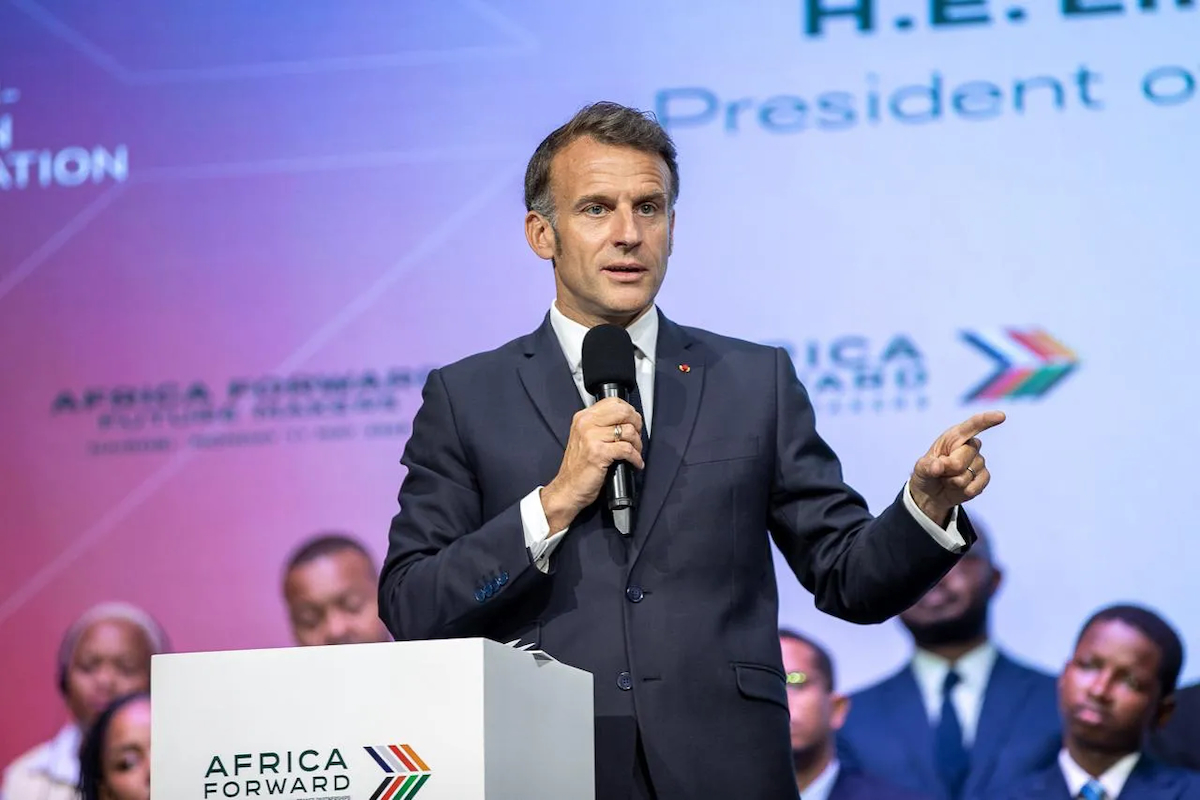
Emmanuel Macron arrives in Nairobi, looks at a room of African heads of state and young Kenyan leaders, and declares, “We are the true pan-Africanists.”

He is, of course, part of the “we” he’s just referred to. Declared with the pomposity of Ludwig Krapf discovering Mt. Kenya.
I’ve only been online intermittently for most of the day. It’s 10.49pm as I start typing this – because I’d just been on Instagram, and Adelle’s post was the third or fourth on my feed.
It found a nerve, and I’ve been typing, googling, deleting, typing, and repeat ad infinitum, ever since.
Some bits of this may feel rough or unpolished. Good. Take a red pen, and circle your corrections and add your additions.
Chapter I: The pan-Africanism of it all.
I read it again.
I looked for the missing word. The misquote. The out-of-context fragment that, once restored to its surrounding sentence, would suddenly make sense. Surely there was a “not” somewhere. Surely there was a qualifier. Surely “we are the true pan-Africanists” was a badly excerpted portion of a longer sentence that began with “critics say” or “some have argued” or even the relatively humble “we all aspire to be.”
Lol. Nope. There was no missing word.
Emmanuel Macron, President of the French Republic, stood at the University of Nairobi (that’s where it was, right?) on the 11th of May 2026, looked around the room of mostly black faces, and said – without apparent discomfort nor hint of shame – “We are the true pan-Africanists.”
And then. And then.
I want to be precise here, because it matters to what’s coming next. He didn’t just claim the label. He made the case. He said, with his full chest:
“We believe that Africa is a continent.”
Transformative revelation, Manu. Can I call you “Manu”? It’s a Kenyan thing – we shorten names like that. Especially with people we know. You know, partners.
Manu said:
“It is the youngest in the world, and therefore has an extraordinary demographic dividend.”
Manu said:
“It is the one with the greatest growth in the world.”

To be a proper writer, I’m supposed to start with the historical context. The Pan-African Congress of 1919. Du Bois. Garvey. Nkrumah. The OAU. I’m supposed to do the whole thing.
I shan’t do that.
Many have already done the history lesson. Many in West and Central Africa – and across Africa, really – have been dissecting the history time and time again, increasingly so over the last 5 years. They do it with more rigour and fury than I can muster right now, and they name every name that needed naming. Farida Bemba Nabourema does it wonderfully – I’ve linked her piece at the end of this.
Which is why I’ll skip right to the frame of mind, because I’m very curious. The specific frame of mind that makes it possible to stand in Nairobi in 2026 and say that sentence with that degree of composure, full chest. Not rhetorically curious. Actually curious. What is the reasoning? What is the internal logic that arrives at, “I, Emmanuel Macron, representative of the nation that recognised and supported Blaise Compaoré’s government for 27 years after he orchestrated the coup that killed Thomas Sankara, am a pan-Africanist”?
A few things, first.
One: “We believe that Africa is a continent.”
Mr. President. Monsieur le President, Sir. Emmanuel. Manu.
A continent is the baseline entry-level fact about a landmass. The Merriam-Webster dictionary believes Africa is a continent. A Grade Four pupil in Kisumu who has looked at the back of an atlas for exactly twelve seconds believes Africa is a continent. A man in a bar in South Texas who has never left his state and whose entire knowledge of the continent begins and ends at “they have lions” believes Africa is a continent.
Believing Africa is a continent isn’t a political philosophy. It would be bold of me to believe I’m vegan because I had bread and kachumbari for breakfast. By this logic, Google Maps is the most pan-Africanist technology ever created – it knows not only that Africa is a continent, but can locate you within it, to within 3 metres, and will suggest the fastest route to the nearest Airtel Money agent. (Because we’ve left M-Pesa – that app is very annoying.) Is Google Maps a pan-Africanist? Should we be redirecting our solidarity statements to Sundar Pichai?
That’s where Manu started. I tried to find the charitable interpretation and I suppose I can chalk this up to another of my many failures. There is no world in which “we believe Africa is a continent” is a qualifying statement for pan-Africanism. None.
Next.
Two: “It is the youngest in the world, and therefore has an extraordinary demographic dividend.”
Friends. This is a market size assessment.
Let me just – let me say that again slowly. This. Is. A. Market. Size. Assessment.
And, perhaps, a labour force evaluation.
“Demographic dividend” – which refers to the economic growth potential associated with a large working-age population relative to dependents – is a phrase you find in a McKinsey report called Africa: The Next Consumption Frontier. It’s the phrase I’ve heard an actual Unilever executive using in pitch before discussing plans to expand into “underserved markets.” It’s what private equity firms say right before launching their “Africa strategy” arm.
So. Just to be clear. His argument for being a pan-Africanist is that he finds young Africans investable. He is saying: I, Emmanuel Macron (Manu), notice that your young people represent a significant economic opportunity and I would like to be present for that opportunity. Forget what history’s implications for such an assessment brought with it – just know that I, Emmanual Macron (Manu), have seen how wonderfully young and able-bodied your people are.
Because I, Emmanuel Macron (Manu), am panafricanist.
In front of Africans. In Nairobi. In 2026.
Pan-Africanism – the actual tradition – is specifically the political philosophy that said African peoples aren’t a dividend. They’re not an investment opportunity to be assessed on a market day by an outside observer. They are fully-formed human beings, with political agency, with the right to determine their own futures on their own terms. Framing a continent’s young people as a “demographic dividend” – as value waiting to be realised – and specifically by a party whose country was so deeply entrenched in (a