
Business
A window into democracy in Africa and the world: In conversation with Prof Staffan Lindberg
The year 2016 was full of surprises. The biggest ones (Brexit, Trump’s election, Jammeh’s exit) were delivered via the ballot box. Democracy may yet have more surprises in store for us in 2017. As the Director of the Varieties of Democracy (V-Dem) Institute at the University of Gothenburg, few people on the planet study democracy and its effect more closely than Professor Staffan I. Lindberg. He spoke to Wycliffe Muga, a Kenyan journalist and political commentator, on what V-Dem’s work reveals about democracy in Africa, why people are now more open to “I can fix this” politicians and much more.

Q: Maybe you could start with some words on the Varieties in Democracy (V-Dem) Project: What gave birth to the idea; how you got started; etc.
This is a long story, but…..
The bustle of democracy measurement activity by many researchers makes it hard to pinpoint the beginning of Varieties of Democracy in an unambiguous way. However, a reasonable starting point is the beginning of sustained collaboration between researchers who are now among the leaders of the project.
In this sense, the collaboration was sparked by 2006-2007 National Research Council consultations that concluded that no democracy indicators existed that were sufficiently fine-grained and reliable to assess the impact of democracy-promotion programs.
Their thinking was summarized in its final report: “Current aggregate national indicators of democracy, such as Freedom House or Polity scores, are neither at the right level for identifying the impacts of particular USAID DG [democracy and governance] projects nor accurate and consistent enough to track modest or short-term movements of countries toward or away from greater levels of democracy.”
The group therefore advocated “[d]eveloping more transparent, objective, and widely accepted indicators of changes in democratic behavior and institutions at the sectoral level. Following up on that conclusion, the NRC and USAID asked John Gerring to convene a January 27-28, 2007 workshop at Boston University to discuss whether better democracy measurement would be feasible, and if so, how it could be done.
V-Dem is a collaboration that draws on expertise from a network of several thousand scholars in almost every country on earth and uses the resulting measures to examine the nature, causes, and consequences of democracy
In preparation for that workshop, Gerring wrote a think-piece that became the first draft of V-Dem’s 2011 Perspectives on Politics article. Few of the workshop attendees became involved in V-Dem, but the day the conference ended, Gerring and Coppedge continued the discussion in person and via e-mail in the next months as they edited Gerring’s paper. Almost without knowing it, the conversation shifted from a hypothetical “how would one go about this?” to something they were actually trying to do.
After a slow start refining the conceptual scheme in 2007-2009, the project grew quickly. Gerring convened a second workshop at Boston University in May 2009, which included Staffan I. Lindberg, Jan Teorell, Svend-Erik Skaaning, Allen Hicken, Jeffrey Staton, and Daniel Pemstein, as well as Gerring and Coppedge.[3] After the second workshop, Gerring, Coppedge, Lindberg, and Teorell constituted themselves as the principal investigators and proceeded to invite other researchers to join as “Project Managers”, who would bring a combination of thematic and regional expertise to the task of writing questions for an online survey of country experts.
By the end of 2009, Steven M. Fish, Kelly McMann, Pamela Paxton, and Michael Bernhard had become Project Managers, and later David Altman, Adam Glynn, Carl Henrik Knutsen, Daniel Pemstein, Patrick Lindenfors, and Brigitte Seim were added. There was a strong feeling that this was an idea whose time had come. This feeling made busy leading scholars surprisingly eager to sign on as Project Managers; and later, helped persuade funders to support the project.
The project took off in mid-2010 with a pilot study, which we named “Varieties of Democracy” in March 2011. With a few research assistants, Excel sheets, and lots of time volunteered by the core team of scholars, we managed to collect 450,000 data points covering two countries from each region of the world.
The pilot study results were presented at a workshop at University of Gothenburg on 30th September 2011, and won pledges of financial support for a full-scale project from the Canadian International Development Agency, its Danish counterpart DANIDA, the Swedish Ministry of Foreign Affairs, and the European Commission/DEVCO. We could start!
Q: And what happened thereafter?
By January 2012, the measurement scheme and indicators were finalized, our first regular staff member Natalia Stepanova started, and data collection began in earnest. By the fall of 2012, we had set up an organization to collect data from most countries of the world. In fall of 2013, two years after the pilot study, data collection was complete for 100 countries, our database included some 10 million records, and we did our first serious validation exercise.

We brought almost all of our Regional Managers to Gothenburg for a week, and together with all Principal Investigators, Project Managers, and methodologists, these records were inspected and evaluated by the team. This important milestone led to the realization that we needed to incorporate Bayesian IRT modeling to achieve cross-country and over-time comparability.
Early results were presented again at a conference on October 25, 2013 at the University of Gothenburg for a mix of donor, government, and international NGO representatives as well as interested scholars and students. Our effort to bridge academic research and the world of practitioners has thus been an ongoing feature of our efforts.
Q: What has been achieved so far?
On April 14, 2014 data for 68 countries (from 1900 to 2012) were released for online graphing and analysis and data for 19 additional countries followed on November 14, 2014. At the end of 2014, we had engaged with 2,153 country experts from 163 countries. By this time, we had funds to do our first partial update covering 2013-2014 for 60 countries and by March 2015 we released the full data for 120 countries for online graphing and analysis.
Q: What would you say is unique about the V-Dem project, especially given that the concept of democracy has already been subjected to very many studies over the years?
There are a number of things that are unique to V-Dem.
V-Dem is a collaboration that draws on expertise from a network of several thousand scholars in almost every country on earth and uses the resulting measures to examine the nature, causes, and consequences of democracy. V-Dem radically alters the way scholars can address these questions.
There has always been a severe tradeoff between providing detailed, rich, nuanced evidence about a few countries based on thick concepts and generalizing about many countries with thinly defined models.
V-Dem makes this tradeoff much less severe because V-Dem data are fine-grained: they include hundreds of specific indicators, most of them measuring differences of degree; but collectively they depict hundreds of differences in kind. At the time same, V-Dem data rate most countries since 1900. They therefore capture both qualitative and quantitative distinctions without sacrificing geographic or historical scope. V-Dem data make it possible to test general hypotheses concerning democracy quantitatively without neglecting crucial qualitative distinctions.
Q: And are there any other ways in which V-Dem differs from other attempts to quantify the advance or the retreat of democratic government?
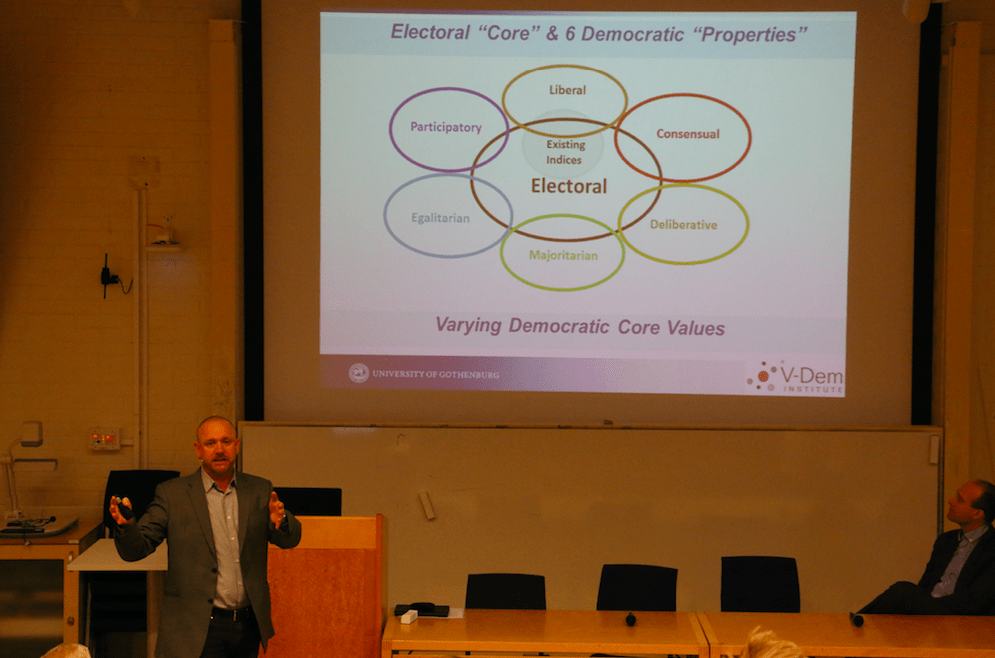
V-Dem is distinctive also in three other respects. First, V-Dem recognizes and respects multiple conceptions of democracy that have long and distinguished intellectual pedigrees. We therefore provide five indices of democracy – and over 35 indices of different components of these – that are specifically designed to map onto the most prevalent theories of democracy.
The core index measures electoral democracy as “polyarchy,” the seminal concept defined by Dahl (1971, 1989, 1995) and its seven – later reduced to five – core constitutive components. The other four are indices of liberal, deliberative, participatory, and egalitarian democracy. A second distinctive feature is captured by the V-Dem slogan, “Global Standards, Local Knowledge”: we rely on more than 2,500 academics and other experts to code countries, of which more than 63 percent are nationals of or residents in the country they code.
V-Dem is not a product of Western experts passing judgment on the rest of the world; each country’s experts rate their own country, and our concepts and methods help ensure international comparability.
Finally, V-Dem is one of the very few democracy measurement programs that take measurement error seriously. We do not pretend to have measured the attributes of democracy with complete accuracy and certainty. Rather, we estimate how certain we can be about each data point and we make this information freely available to the public.
V-Dem is a project of unprecedented scope in the social sciences. The dataset, which contains more than 16 million observations and continues to grow, is the world’s largest expert-rating dataset. Behind the dataset is a complex data collection infrastructure and seven years of effort by a large organization comprising four Principal Investigators (PIs), thirteen Project Managers (PMs), six postdoctoral Research Fellows (RFs), five Program and Data Managers, many graduate and undergraduate research assistants, 37 past and present Regional Managers (RMs), more than 160 Country Coordinators (CCs), and about 2,500 Country Experts (CEs).
V-Dem is not a product of Western experts passing judgment on the rest of the world; each country’s experts rate their own country, and our concepts and methods help ensure international comparability
About fifteen of these people, and the data collection infrastructure, are based at the V-Dem Institute at the University of Gothenburg, which has become the project’s de facto headquarters; the rest are dispersed all over the world. The Kellogg Institute for International Studies at the University of Notre Dame serves as the home institution for North America, and V-Dem also has regional centers in Estonia and Portugal.

Q: From your point of view, what has the V-Dem project contributed to the better understanding of democratic governance?
I think most of the lessons are still to come; we have just begun to scratch the surface of what can be learnt from the over 16 million data on democracy that V-Dem provides.
Q: And what aspects of democracy would you say that your approach has somewhat failed to shine a light on?
In the present time, with countries facing challenges from Hungary and France to the USA, it is clear that we omitted creating measures of populism and leadership styles that right now would have been very important and useful.
Q: Is there