
Politics & Society
The Big Thursday Briefing: The constitution of code: A Geosociotechnopolitical perspective on digital constitutionalism in Africa
Why sovereignty, artificial intelligence, and digital governance must become constitutional questions.

Published
4 months agoon
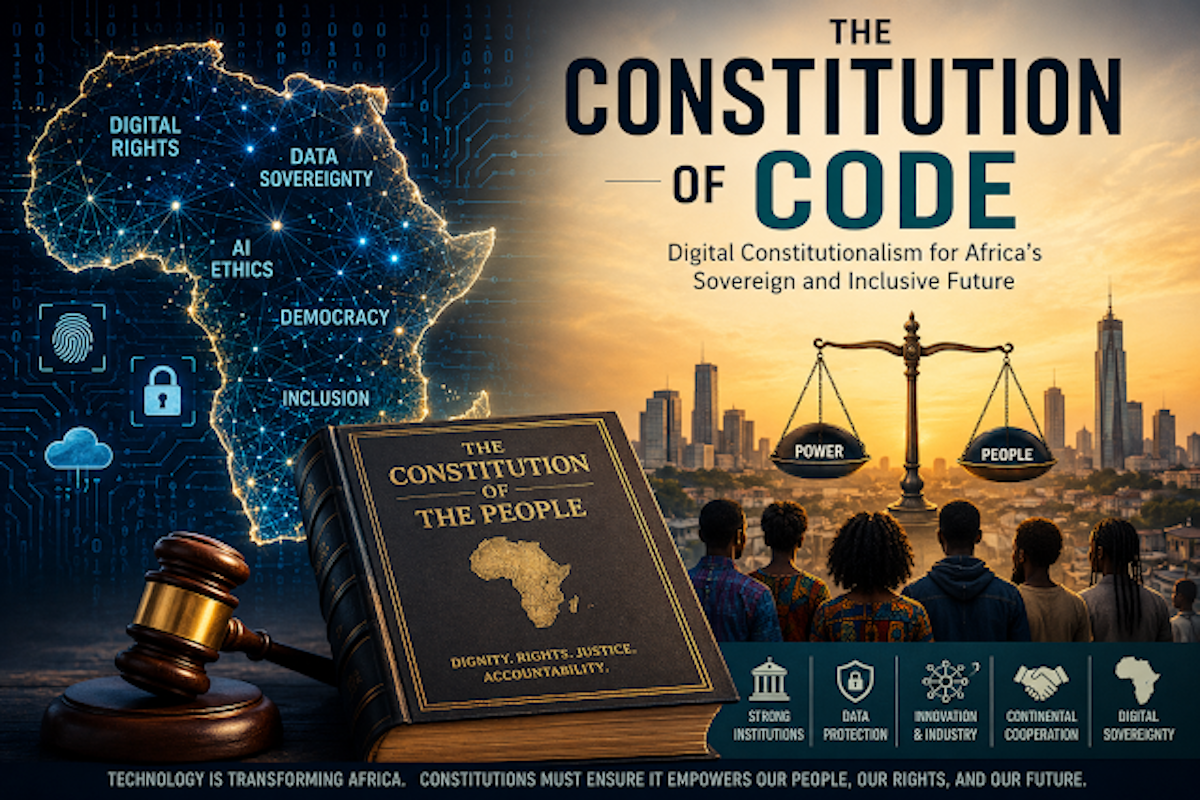
Introduction: The Hidden Constitution of the Digital Age
In the previous edition of The Big Thursday Briefing, we argued that China–Africa ICT relations can no longer be understood through familiar binaries such as dependency versus partnership or “zhing zhong” versus technological superiority. Drawing on my doctoral research, I suggested that the deeper story is geosociotechnopolitical: the emergence of new forms of power embedded in digital infrastructures that increasingly shape how societies function, economies operate, and states exercise authority.
That argument carries an important implication. If technology is becoming part of governance itself rather than merely a tool of governance, then constitutions can no longer concern themselves only with presidents, parliaments, courts, and elections. They must also engage with the technological systems through which power is exercised.
This article takes that argument one step further. The question is no longer simply who builds Africa’s digital infrastructure. The more consequential question is who governs the power embedded within it.
Across Africa, governments are rapidly adopting digital identity systems, biometric databases, artificial intelligence applications, cloud infrastructure, surveillance technologies, digital payment platforms, and algorithm-driven public services. These developments are usually discussed in technical language—procurement, implementation, cybersecurity, innovation, and efficiency. Yet beneath this language lies a deeper political reality. Digital technologies increasingly determine who the state recognises, who gains access to public services, how information circulates, how citizens are monitored, and how decisions affecting millions of people are made.
In short, they are reshaping the relationship between citizens and power.
Most African constitutions were designed for an analogue era. They were drafted before artificial intelligence, biometric identification, predictive algorithms, platform-mediated public life, and cross-border data flows became central features of governance. While constitutions regulate legislatures, executives, and courts with considerable precision, they remain largely silent on the infrastructures through which digital power increasingly operates.
This silence has created a profound constitutional challenge. As technology becomes embedded in the machinery of the state, decisions with far-reaching implications for sovereignty, citizenship, privacy, accountability, and democracy are frequently treated as technical or administrative matters rather than constitutional ones.
The central claim of this article is straightforward but consequential: digital systems are no longer merely technological infrastructure. They are becoming part of the constitutional architecture through which power is organised, exercised, and contested. Like constitutions, parliaments, and courts, they allocate power, structure participation, shape rights, and influence sovereignty.
The argument unfolds in four stages. First, it examines how digital technologies are transforming the exercise of power. Second, it explores why constitutional frameworks designed for an analogue age struggle to govern digital societies. Third, it considers what constitutionalising the digital might look like in practice, drawing lessons from Zimbabwe and broader African experiences. Finally, it argues that the African Union should lead the development of a continental framework for digital constitutionalism and digital sovereignty.
If the twentieth century was defined by the constitutionalisation of political power, the twenty-first century will increasingly be defined by the constitutionalisation of digital power.
When Code Becomes Power
Political theorists have long understood that power is exercised through institutions. Parliaments enact laws, courts interpret them, governments implement them, and elections provide mechanisms through which authority is granted or withdrawn.
Digital technologies do not replace these institutions. Rather, they increasingly operate alongside them—and, in some cases, through them.
Consider a national digital identity system. At first glance, it appears to be an administrative tool designed to improve efficiency. In practice, however, it determines who can access government services, open bank accounts, vote, receive social protection, or participate fully in economic life. The system becomes a gatekeeper to citizenship in ways that extend far beyond administration.
A similar dynamic is visible in the growing use of artificial intelligence within public administration. AI systems may influence eligibility for welfare programmes, guide law-enforcement priorities, or shape decisions concerning employment, education, and healthcare. The algorithms behind these systems are often invisible to citizens, yet they can profoundly affect outcomes for millions of people.
Social media platforms provide a third example. They have become central arenas for political communication, public opinion formation, electoral mobilisation, and social activism. Decisions taken by private technology companies increasingly shape what information citizens encounter, what narratives gain prominence, and which voices remain marginalised.
Taken together, these developments point to a broader transformation. Power is no longer exercised exclusively through constitutions, statutes, and public institutions. It increasingly operates through code, data, algorithms, and digital infrastructures.
Lawrence Lessig famously observed that “code is law” (Lessig 1999). His argument was not that software replaces legislation, but that technological architectures regulate behaviour in ways comparable to legal rules. A platform algorithm can influence conduct as effectively as a legal prohibition. A digital identity system can determine inclusion or exclusion as decisively as administrative legislation.
For African societies, this raises profound questions. Who controls the code? Who owns the data? Who designs the algorithms? Which values become embedded within technological systems? And how can democratic oversight be maintained when power increasingly operates through infrastructures that most citizens neither see nor fully understand?
These are not merely technical questions. They are constitutional questions.
The Analogue Constitution in a Digital World
Most African constitutions emerged during the democratic transitions of the 1990s and early 2000s. Their architects confronted visible and institutional threats: executive dominance, one-party rule, electoral manipulation, weak legislatures, and inadequate judicial oversight. Their objective was to constrain political power, strengthen democratic accountability, and entrench fundamental rights.
Those achievements remain among the most significant constitutional gains of the post-Cold War era.
Yet the technological environment within which those constitutions now operate has changed dramatically.
Few constitutional drafters could have anticipated a world in which billions of digital interactions generate vast quantities of personal data every day; where governments maintain biometric databases capable of identifying citizens in real time; where artificial intelligence influences decisions about welfare, education, healthcare, employment, and policing; or where global technology platforms mediate political communication on a scale that rivals traditional media institutions.
Consequently, most constitutions were designed to regulate human institutions rather than technological architectures. As digital constitutionalism scholars have observed, constitutional frameworks around the world are increasingly struggling to govern forms of power exercised through digital systems rather than traditional state institutions (Celeste 2022).
They define the powers of presidents, parliaments, courts, and local authorities with considerable precision, yet remain largely silent on the infrastructures that increasingly shape governance itself.
This silence has produced what may be called a constitutional gap.
Many constitutional rights remain applicable in principle, but they often provide only indirect guidance for governing digital societies. Privacy provisions may protect citizens against unlawful searches while offering limited clarity regarding the ownership, storage, and governance of biometric data. Freedom of expression guarantees the right to speak and publish but rarely addresses the influence of algorithmic systems that determine visibility within public discourse. Equality clauses prohibit discrimination by public authorities yet often say little about algorithmic bias, automated decision-making, or forms of exclusion generated by digital systems.
The challenge is therefore not simply that technology creates new threats to existing rights. More fundamentally, technology is transforming the architecture through which power itself operates.
Surveillance illustrates the shift clearly. Constitutional concerns once centred on physical monitoring, intercepted communications, and unlawful searches. Today, biometric identification systems, predictive analytics, and artificial intelligence enable forms of continuous monitoring that previous generations could scarcely imagine.
The same transformation is evident in public discourse. The constitutional question is no longer only whether governments can restrict speech. Increasingly, digital platforms shape public debate before any law is applied at all. Recommendation algorithms influence which information gains prominence, which narratives become dominant, and which voices remain unheard.
This evolution has profound constitutional implications because constitutions have always been concerned with governing power. If power increasingly operates through digital systems, constitutional thinking must evolve accordingly.
Across Africa, governments are investing heavily in digital identity systems, AI strategies, cloud infrastructure, digital payment ecosystems, and data governance frameworks. Yet constitutional development has not kept pace with technological change. Twenty-first-century digital systems are being built within constitutional frameworks largely designed for a twentieth-century political environment.
The consequence is that decisions affecting sovereignty, citizenship, privacy, accountability, and democratic participation are frequently treated as technical, administrative, or procurement matters rather than constitutional questions.
That imbalance matters because digital systems are no longer merely instruments of governance. They are increasingly becoming part of governance itself.
The challenge facing African constitutionalism is therefore not simply to defend existing rights against new technologies. It is to ensure that constitutional principles of accountability, participation, transparency, and democratic oversight remain effective in a world where power increasingly flows through digital systems.
Africa’s Emerging Constitutional Gap
Across Africa, digital transformation is advancing at remarkable speed. Governments are investing in biometric identity systems, smart-government platforms, artificial intelligence strategies, cloud infrastructure, cybersecurity frameworks, and digital payment ecosystems, reflecting priorities articulated in the African Union’s Digital Transformation Strategy for Africa (2020–2030) (African Union 2020).
Yet they also expose a growing constitutional dilemma.
Historically, constitutions were designed to govern visible centres of authority. Presidents exercised executive power. Legislatures enacted laws. Courts interpreted them and protected rights. Constitutional safeguards emerged to ensure that these institutions remained accountable to citizens and operated within clearly defined limits.
Today, however, some of the most consequential exercises of power occur through technological systems that often sit outside traditional constitutional scrutiny. Decisions about identity, access to services, information flows, data collection, and citizen monitoring are increasingly mediated through digital infrastructures.
The problem is not that these systems replace political institutions. Rather, they shape how those institutions function.
This shift matters because many of the most consequential technological decisions continue to be treated as technical or administrative matters rather than constitutional ones. Governments may devote extensive public debate to constitutional amendments while approving national biometric databases through ordinary administrative processes. Parliaments may scrutinise electoral reforms in detail while paying comparatively little attention to cloud-computing agreements that determine where national data is stored and who can access it. Artificial intelligence systems may be introduced into public administration with minimal public consultation despite their potential impact on rights, accountability, and democratic participation.
Increasingly, questions traditionally associated with constitutional governance are being answered through technological design (Yeung 2018). Who is recognised by the state? Who gains access to services? Who controls information? Who owns national data? Who has the capacity to monitor citizens? These are no longer purely legal or political questions. They are increasingly embedded within databases, algorithms, and digital infrastructures.
The challenge is particularly significant for Africa because the continent is simultaneously experiencing rapid digital expansion and ongoing democratic consolidation. Unlike older industrial powers that developed constitutional systems long before the emergence of digital technologies, many African states are strengthening democratic institutions while navigating a technological transformation in real time.
This creates both risks and opportunities.
The risk is that technological infrastructures become deeply embedded before adequate democratic safeguards are established. Decisions made today regarding digital identity systems, artificial intelligence governance, cloud infrastructure, cybersecurity, and cross-border data flows may shape governance for decades.
The opportunity is that Africa is not merely inheriting a completed digital order. The continent still has the capacity to shape the constitutional foundations of its digital future. Rather than reproducing models developed elsewhere, African countries can develop approaches that reflect their own constitutional traditions, developmental priorities, and democratic aspirations.
The constitutional challenge facing Africa is therefore not whether digital technologies affect governance. They already do. The real question is whether constitutional governance can evolve quickly enough to govern digital power.
That question lies at the heart of the emerging politics of the digital age.
From Harare to Nairobi: Digital Power in Everyday Life
Discussions about algorithms, data governance, and digital sovereignty can sometimes appear abstract. Yet across Africa, digital power is already shaping how citizens interact with governments, access services, participate in economic life, and exercise their rights.
Kenya’s Huduma Namba programme generated significant constitutional debates concerning privacy, citizenship, and exclusion (Nubian Rights Forum v Attorney General, 2020). Introduced as a national digital identity initiative, it was presented primarily as an administrative reform intended to improve efficiency and service delivery. The public debate that followed, however, quickly moved beyond technology. Civil society organisations, legal practitioners, and citizens raised concerns about privacy, exclusion, data protection, and citizenship. What began as an ICT project became a constitutional debate about rights, accountability, and state power.
Similar dynamics are visible elsewhere across the continent.
In South Africa, digital systems increasingly influence the administration of social grants and public services. In Nigeria, digital payment platforms have transformed economic transactions and expanded financial inclusion while simultaneously raising questions about data security, regulatory oversight, and market concentration. In Ethiopia, ambitious digital identity initiatives promise administrative efficiency but also provoke important debates about surveillance, inclusion, and governance.
Zimbabwe offers an equally revealing example. The rise of EcoCash fundamentally transformed the country’s economic landscape. What began as a mobile money platform evolved into critical national infrastructure used by millions of citizens. During periods of economic instability, digital financial systems became indispensable mechanisms for commerce, savings, and everyday transactions. Digital financial ecosystems such as EcoCash demonstrate how technological platforms can evolve into critical national infrastructure that shapes economic participation and state-society relations (Mhlanga 2020).
Yet EcoCash was never merely a technological innovation. It reshaped relationships between citizens, businesses, financial institutions, and the state. Decisions regarding regulation, access, and control carried implications that extended far beyond technology itself. Economic participation increasingly depended upon digital systems that had become embedded within everyday life.
The same pattern is evident in the sphere of communication. Across Africa, platforms such as Facebook, X, TikTok, WhatsApp, and YouTube have become central arenas for political debate, activism, election campaigning, and information sharing. Citizens increasingly encounter politics through algorithmically curated feeds rather than traditional newspapers or broadcasters. Protest movements organise through digital networks. Governments communicate through social media channels. News travels through platforms whose governing rules are often written far beyond the jurisdictions in which they operate.
The result is a profound transformation. Power is no longer exercised exclusively through constitutions, statutes, and public institutions. It increasingly operates through code, data, algorithms, and digital infrastructures (Kitchin 2017; Zuboff 2019). Decisions taken by platform companies regarding content moderation, algorithmic recommendations, or account suspensions can shape political participation as significantly as decisions taken by public institutions. The infrastructure of communication has itself become a site of political power.
The COVID-19 pandemic accelerated many of these trends. Governments adopted digital tools to manage public-health responses, distribute information, and deliver services. Educational systems shifted online. Businesses expanded digital operations. Citizens increasingly relied upon digital platforms for work, communication, and commerce. At the same time, the pandemic exposed inequalities in access, connectivity, and digital capability that continue to shape participation in public life.
These developments reveal a central insight of geosociotechnopolitics: technology does not simply operate within society; it actively reshapes social, political, and economic relationships. Digital infrastructures influence who participates in economic life, how citizens engage with government, how information circulates, and how power is exercised.
The challenge is therefore no longer whether digital technologies affect governance and citizenship. They already do. The challenge is whether constitutional frameworks can evolve quickly enough to govern these new forms of power democratically.
Zimbabwe and the Constitutional Question
Zimbabwe provides a particularly useful lens through which to understand the constitutional challenges emerging across Africa’s digital transformation.
The country’s experience sits at the intersection of several developments explored throughout this series: digitalisation, constitutional reform, debates over sovereignty, and the growing influence of global technological ecosystems. In many respects, Zimbabwe functions as a microcosm of broader Africa–China technological relations and the wider transition toward an emerging technomultipolar order.
My doctoral research began with a relatively straightforward question: how had Chinese information and communication technologies become so deeply embedded in Zimbabwean society? What initially appeared to be a story about technology diffusion soon revealed a much broader transformation. Telecommunications networks, smartphones, surveillance systems, digital platforms, and cloud infrastructures were not simply entering Zimbabwe as products. They were becoming embedded within economic activity, social life, governance systems, and international relations.
This transformation exposed a significant theoretical gap. Traditional frameworks such as geopolitics, development studies, and dependency theory could explain aspects of the phenomenon, but none adequately captured the interaction between technology, society, politics, and geography unfolding simultaneously. It was this gap that led to the development of geosociotechnopolitics.
Zimbabwe’s experience also illustrates a challenge increasingly visible across Africa: technological adoption often advances more rapidly than democratic oversight. Governments can deploy biometric systems, artificial intelligence tools, surveillance technologies, and digital identity platforms far more quickly than constitutional frameworks can adapt to regulate them. As a result, decisions with profound implications for citizenship, privacy, accountability, and sovereignty are frequently treated as technical matters rather than constitutional questions.
The debate surrounding Constitutional Amendment Bill No. 3 offers an instructive contrast. Public discussion focused intensely on democratic safeguards, public participation, constitutional procedure, and the protection of sovereignty. At the centre of these debates stood Section 328 of the Constitution, which establishes heightened procedures for amendments affecting foundational provisions such as citizenship, executive term limits, and fundamental rights (Constitution of Zimbabwe Amendment (No. 20) Act, 2013).
The principle underlying Section 328 is straightforward but profound: some decisions are too consequential to be left to ordinary legislative processes. When changes affect the architecture of the state or the rights of citizens, deeper scrutiny, broader consultation, and stronger democratic legitimacy are required.
The digital age compels us to apply that same principle to a new domain.
If altering presidential term limits requires enhanced constitutional safeguards because it reshapes political power, why should the creation of a national biometric database that redefines the practical conditions of citizenship not receive comparable scrutiny? If amendments affecting rights require heightened democratic procedures, why should decisions regarding artificial intelligence systems that increasingly influence access to welfare, employment, credit, or justice be treated as routine procurement exercises? If agreements affecting territorial sovereignty trigger constitutional safeguards, why should arrangements that place citizen data under foreign jurisdictions proceed with minimal public debate?
These are no longer hypothetical concerns.
Digital identity systems increasingly determine access to public services and economic participation. Artificial intelligence systems are beginning to influence administrative decision-making at scale. Cloud-computing agreements shape where national data resides and which legal regimes govern it. Cross-border data arrangements increasingly influence the practical meaning of sovereignty in the digital age (Floridi 2018).
Yet many of these decisions continue to be framed primarily as technical matters.
This creates a democratic imbalance. Citizens may spend months debating constitutional amendments while digital infrastructures capable of shaping governance for decades are approved with comparatively little scrutiny. The formal constitution receives intense public attention while a parallel architecture of digital governance emerges largely beyond constitutional debate.
Constitutionalising the digital, therefore, means recognising that technological governance is no longer separate from constitutional governance. When code determines inclusion, when algorithms allocate resources, and when data infrastructures shape sovereignty, those decisions carry constitutional significance regardless of whether they are described as technology policy.
Zimbabwe’s constitutional experience demonstrates that citizens already understand the importance of democratic safeguards when power is being reorganised. The challenge now is extending that constitutional logic into the digital realm.
Digital Sovereignty Beyond Infrastructure
The concept of digital sovereignty has moved rapidly from academic debate to the centre of policy discussions across Africa. As digital technologies become embedded within governance, commerce, and everyday life, questions about technological control have become inseparable from questions about political and economic autonomy.
Too often, however, digital sovereignty is reduced to infrastructure alone.</